


There was a season of my life when I felt like I was watching myself from somewhere just behind my own eyes. I showed up to work, kept up friendships, and did what needed to be done, but none of it felt fully real. It felt like living behind a pane of glass.
If you have ever felt numb, foggy, far away, or like you are going through the motions on autopilot, I want you to know two things. You are not broken. And there are real, research-backed ways to find your way back.
This is not an article about what is wrong with you. It is an article about what you can do, starting today.
Why Your Body Learned to Leave
The clinical word for feeling detached from reality is dissociation. Most of us have felt a mild version of it, like driving home and not remembering the drive. On the stronger end, it can feel like your body does not belong to you, or like the world around you is flat and dreamlike.
Dissociation is not a flaw. It is protection. When we face something overwhelming that we cannot fight or escape, the brain can turn the volume down on what we feel. In the moment, that is brilliant biology. It helps us survive.
The problem comes later. After repeated stress, trauma, grief, illness, or a long season of not feeling safe, the nervous system can learn that disconnecting is the default. A hard conversation or a stressful day becomes enough to trigger the same retreat.
Researchers also study something called interoception, your ability to sense what is happening inside your body, like your breath, heartbeat, tension, and hunger. Many people who have been through hard experiences learn to tune these signals out, because feeling the body once meant feeling pain.
Here is the hopeful part. You did not choose what taught your body to disconnect. But the same brain that learned to leave can learn to come back. You cannot always think your way out of dissociation, so the way back runs through the body.
Here are five practices, what the research actually says about each one, and exactly how to start.
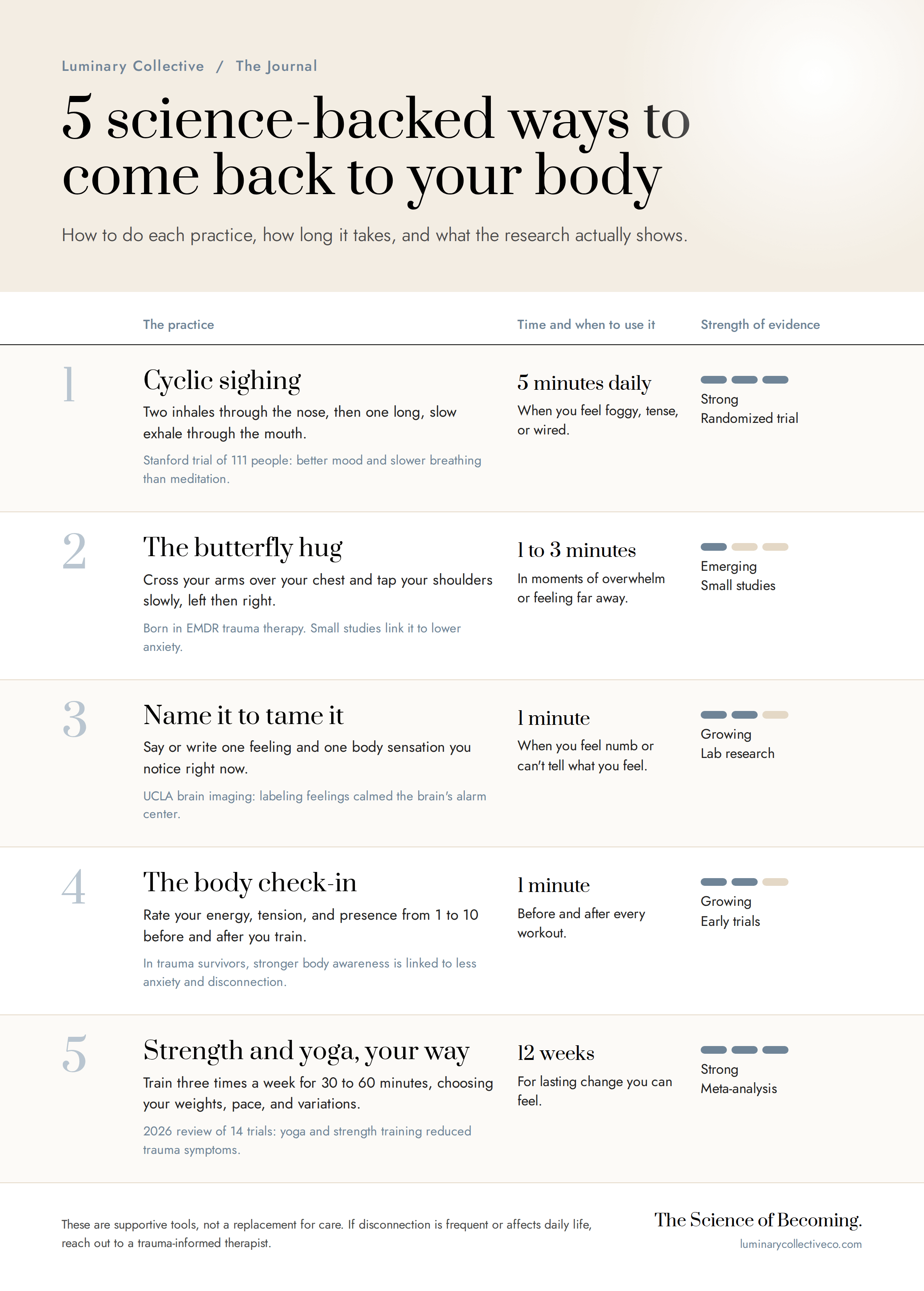
1. Cyclic Sighing: Five Minutes That Shift Your Mood
If you try only one practice from this article, make it this one.
How to do it: Breathe in through your nose until your lungs feel full. Then take a second, shorter sip of air on top of it. Slowly exhale through your mouth until all the air is gone, letting the exhale be longer than the inhale. Repeat for five minutes.
What the research shows: In a Stanford randomized controlled trial, 111 people practiced one of three breathing techniques or mindfulness meditation for five minutes a day for a month. Cyclic sighing produced the greatest improvement in mood and the biggest drop-in resting breathing rate, even more than meditation.
Long exhales help shift your nervous system toward its rest and recover state. And because breathing sits right at the edge of automatic and conscious control, it is one of the fastest ways to take the wheel back.
Try it: Stack it onto something you already do, like right after you brush your teeth at night.
2. The Butterfly Hug: Calm You Can Carry Anywhere
How to do it: Cross your arms over your chest so your fingertips rest just below your collarbones. Slowly tap one side, then the other, like the wings of a butterfly. Keep your breath slow and steady for one to three minutes. If you are somewhere public, alternate tapping your thighs under a desk instead.
What the research shows: The butterfly hug was created by therapist Lucina Artigas in the late 1990s to support survivors of Hurricane Pauline, and it is still used today in EMDR, one of the leading trauma therapies. The rhythmic left and right tapping is a form of bilateral stimulation, and early studies link it to lower anxiety across different groups of people. The research is still small, so think of it as a promising tool rather than a cure.
One important note: If tapping ever brings up difficult memories or feelings, stop and return to your breathing. Grounding should feel like support, not something you push through.
3. Name It to Tame It: Put Words to What You Feel
When you feel disconnected, you often cannot tell what you are feeling at all. This practice gently opens that door.
How to do it: Say out loud or write down one feeling and one body sensation you notice right now. It can be as simple as, “I feel far away, and my jaw is tight.” There are no wrong answers. Even “I feel nothing” counts as noticing.
What the research shows: In a well-known UCLA brain imaging study, simply labeling emotions reduced activity in the amygdala, the brain’s alarm center, while increasing activity in a region of the prefrontal cortex tied to regulation. The researchers describe the effect as modest, which is exactly why it works best as a daily habit rather than a one-time fix.
Try it: Keep a note on your phone or a journal by your bed and write one line each evening.
4. The Body Check-In: Rebuild Trust With Your Signals
This is where fitness becomes a reconnection practice.
How to do it: Before and after every workout, take one minute and rate three things from 1 to 10: your energy, your tension, and how present you feel. Then name one sensation you can clearly feel, like your heartbeat, warm muscles, or your feet on the floor.
What the research shows: In a study of 62 women taking part in a six-week trauma-sensitive yoga program, becoming more responsive to body signals helped explain why their anxiety and psychological discomfort went down. In another program focused on body awareness, reductions in feeling disconnected from the body contributed directly to fewer trauma-related symptoms.
In other words, learning to notice your body again is not a side effect of healing. It may be one of the ways healing happens.
Try it: Write your numbers in a notes app. Over a few weeks, you will have visible proof that you are becoming more present.
5. Strength and Yoga, Your Way: The Long-Term Rewire
The first four practices help in the moment. This one creates lasting change.
How to do it: Train three times a week for 30 to 60 minutes, combining strength training, yoga, or Pilates. Slow your reps down and feel which muscles are working. Most importantly, build in choice: pick your weight, your pace, your variation, and when you rest.
What the research shows: A 2026 review of 14 randomized trials found that exercise significantly reduced trauma symptoms, with yoga and resistance training standing out as especially effective. The best results came from three sessions a week of 30 to 60 minutes over 12 weeks, and women appeared to benefit even more.
Why does choice matter? Dissociation often comes with a feeling of having no control over your own body. Trauma-informed researchers are exploring how offering small, real choices during mindful practice can help people rebuild that sense of agency. Every time you decide how to move, you are reminding your nervous system that you are the one in charge.
Lifting something heavy also asks you to be here. You feel your grip, your feet pressing into the floor, and your muscles working. Every rep becomes a small conversation between you and your body, and every set is proof that your body is capable and strong.
Your 5-Minute Daily Reset
You do not need an hour. When you feel yourself drifting, try this:
Feet down (30 seconds). Press your feet into the floor and name three things you can see.
Cyclic sighing (2 minutes). Two inhales through the nose, one long exhale through the mouth.
Butterfly hug (1 minute). Slow alternating taps while you keep breathing.
Name it (1 minute). One feeling and one body sensation.
Choose (30 seconds). Make one small intentional choice for your next hour, like a walk, a glass of water, or a stretch.
When to Get Extra Support
These practices are powerful, and they work best alongside the right care. If feeling detached happens often, lasts a long time, affects your ability to work or take care of yourself, involves losing chunks of time, or connects to trauma you have not had space to process, please reach out to a trauma-informed therapist. Approaches like EMDR and somatic therapy are designed for exactly this. Movement is not a replacement for that care. It is a wonderful partner to it.
Coming Home
Healing from detachment is not about forcing yourself to feel everything at once. It is about gently proving to your body, again and again, that it is safe to be here.
Every long exhale, every tap, every named feeling, and every slow rep is a vote for presence. You did not choose what taught your body to leave. But through awareness and practice, you get to become the author of what comes next.
Your body has been waiting for you. Welcome home.
If you want support building these practices into your life, the Root Program was designed exactly around this. Subscribe to continue with me on our journey of healing and self-growth to build out the reality you deserve.
With Warmth,
-Hannah