


There is a particular kind of guilt many women carry about rest.
You take a day off and something in you whispers that you are falling behind. That the woman who is really committed would have trained today. That rest is what you allow yourself when you have run out of willpower, not something you choose on purpose.
I want to dismantle that, because it is not just unkind. It is biologically backwards.
Here is what is actually true: your body does not get stronger during your workout. Your workout is only the signal. The strength itself gets built afterward, in the hours and days you spend recovering. Which means rest is not the thing that interrupts your progress. Rest is where your progress actually happens.
What your workout really does
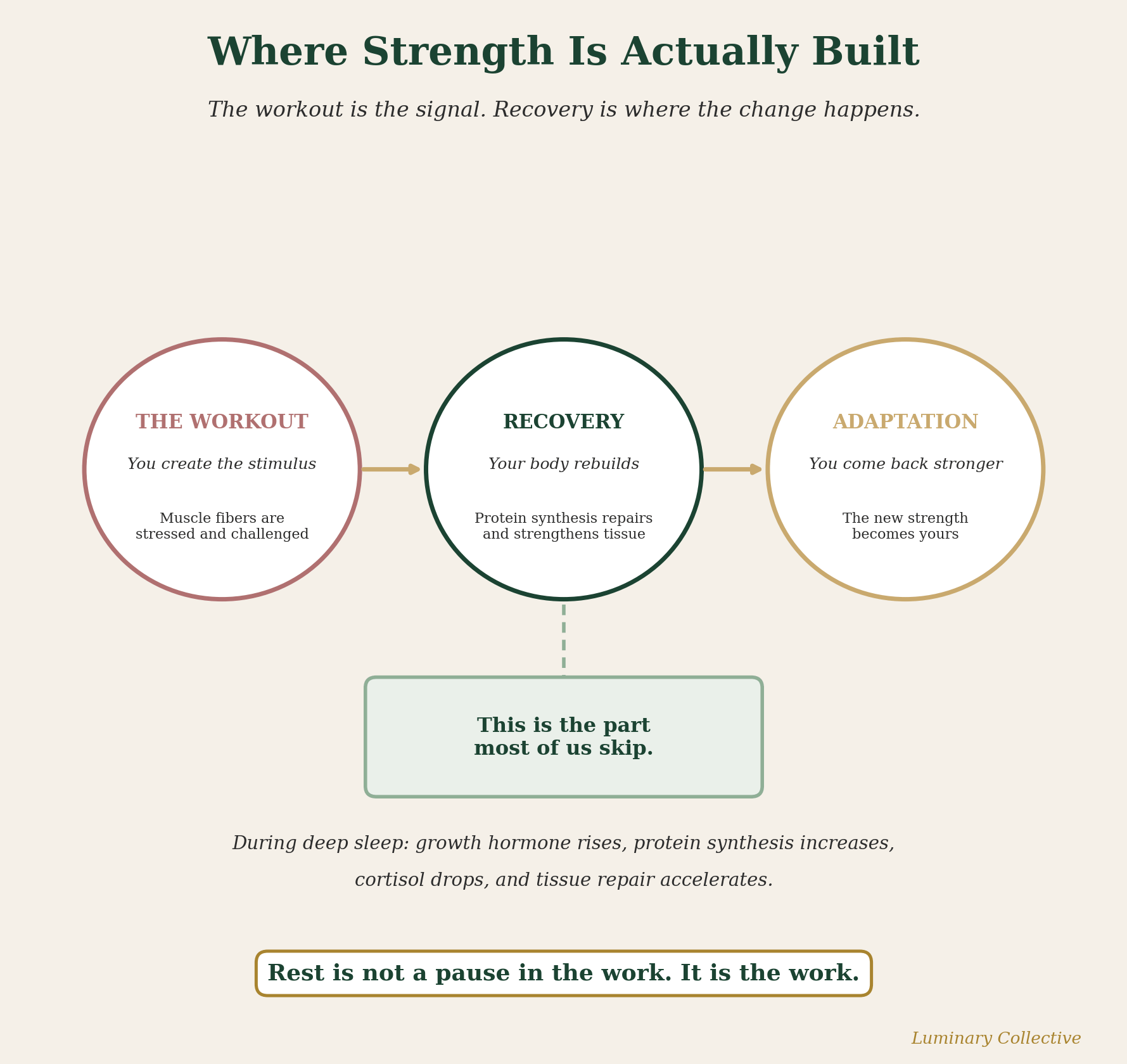
When you train, you are not building anything yet. You are creating a demand. You stress the muscle fibers, challenge the tissue, and send your body a very specific message: this was hard, and we need to be more capable next time.
That is the whole job of the workout. It is the request.
What happens next is where the transformation occurs. Your body responds to that request by repairing the tissue and building it back stronger than before, a process driven by muscle protein synthesis, which continues for a day or two after you train. During that window, your body is doing the actual construction. The workout wrote the order. Recovery fills it.
This is why more is not automatically better. If you keep sending demand signals without ever giving your body the conditions to complete the building, you accumulate stress without accumulating strength. You end up tired, sore, and frustrated that your effort is not showing up in your body, when the effort was never the missing piece. The completion was.
Sleep is where the building happens
If recovery is the construction site, sleep is when the crew shows up.
During deep sleep, growth hormone rises, muscle protein synthesis increases, cortisol drops, and tissue repair accelerates. Nearly every process your body uses to make you stronger runs most powerfully while you are asleep. Growth hormone activity during sleep is a critical mechanism behind the recovery and structural renewal of muscle tissue.
And when sleep is short, the building slows measurably. Research has found that restricting sleep to about four hours a night for five nights reduced muscle protein synthesis by roughly eighteen to nineteen percent. That is not a small penalty. That is you doing the hard work in the gym and then quietly leaving a fifth of the results on the table.
One rough night will not undo your progress. But a pattern of short sleep caps how strong you can become, no matter how well you train or eat. Chronic sleep restriction reduces strength adaptation, increases fatigue, and raises injury risk. You cannot out-train an unrecovered body.
Why this matters especially for women
There is a layer here that deserves naming. Many of us were taught that discipline means pushing through, that the more depleted we feel, the more virtuous the effort must have been. So we train hard, sleep too little, and treat rest as something to be earned rather than something the body requires.
But a body already running on chronic stress, with cortisol elevated and a nervous system stuck in a state of alert, is not in a good position to build anything. It is in survival mode, and survival mode does not prioritize making you stronger. It prioritizes getting you through the day.
This is why I refuse to separate training from nervous system regulation in the work I do. Recovery is not just the absence of exercise. It is the presence of safety. When your body gets the signal that the emergency is over, that it is safe to repair and rebuild, it does exactly that. Rest days, sleep, slow breathing, gentle movement, these are not the soft parts of a program. They are the conditions under which everything else you are doing finally becomes real.
What this means for you
If you have been training hard and feeling stuck, exhausted, or like your effort is not translating, I want you to consider that you may not need to add more. You may need to complete what you have already started.
Here is where to begin.
Treat rest days as training days. They are not days off from your program. They are the days your program pays out. Schedule them, protect them, and stop apologizing for them.
Protect your sleep like it is part of your workout. Because it is. A consistent bedtime, a wind-down routine, and a dark, cool room will do more for your strength than another session you did not have the resources to recover from.
Move gently instead of stopping entirely. Recovery does not have to mean stillness. A walk, mobility work, or slow, breath-led movement supports circulation and regulation without adding demand. This is why recovery days in my program still include movement, just a different kind.
Notice the difference between soreness and depletion. Productive training leaves you tired but capable. Chronic under-recovery leaves you flat, foggy, and dreading movement. Learning to tell them apart is one of the most useful skills you can build.
The bigger picture
This is the heart of what I believe and what Luminary Collective is built on. Being strong is not about how much you can endure. It is about how well you can build, and building requires both the demand and the recovery. One without the other is not discipline. It is just depletion.
Choosing rest is not a failure of commitment. It is one of the clearest ways you can be an ally to your own body, giving it not just the challenge but the conditions it needs to meet that challenge and become more.
You did not choose a body that needs recovery. Every human body does. But you can choose to stop fighting that truth and start working with it, and watch what your body does when you finally let it finish what you started.
If you are new here, this idea, that you are one integrated biology and can work with it rather than against it, is the foundation of everything I write. You can read where it all begins in my welcome post.
So the next time you take a rest day, do not brace for guilt. You are not stepping away from the work. You are exactly in the middle of it.
With warmth, Hannah