


You already know the feeling. The decision you couldn’t explain but knew in your gut. The knot in your stomach before something hard. The stressful week that unsettles your digestion right alongside your mind.
We say these things constantly. A gut feeling. Butterflies. Something we can’t stomach. And we treat them as figures of speech, never realizing they describe something literally, biologically real.
Your gut and your brain are in constant conversation. And once you understand it, you gain something powerful: a new way to change how you feel, starting from your body.
Let me show you.
You have a second brain
Your gut contains its own vast network of neurons, so extensive that scientists call it the enteric nervous system. It produces more than 30 neurotransmitters and has more neurons than the spine. In a real sense, it is a second brain.
And here is the fact that changes everything. Serotonin, the molecule most tied to mood and wellbeing, the one many antidepressants target, is not mostly made in your head. It is produced predominantly by cells in your gut. Around ninety percent of your serotonin is made in your digestive tract.
Read that again. The chemistry of feeling good is largely manufactured in a system you influence every single day by how you live.
How the conversation works
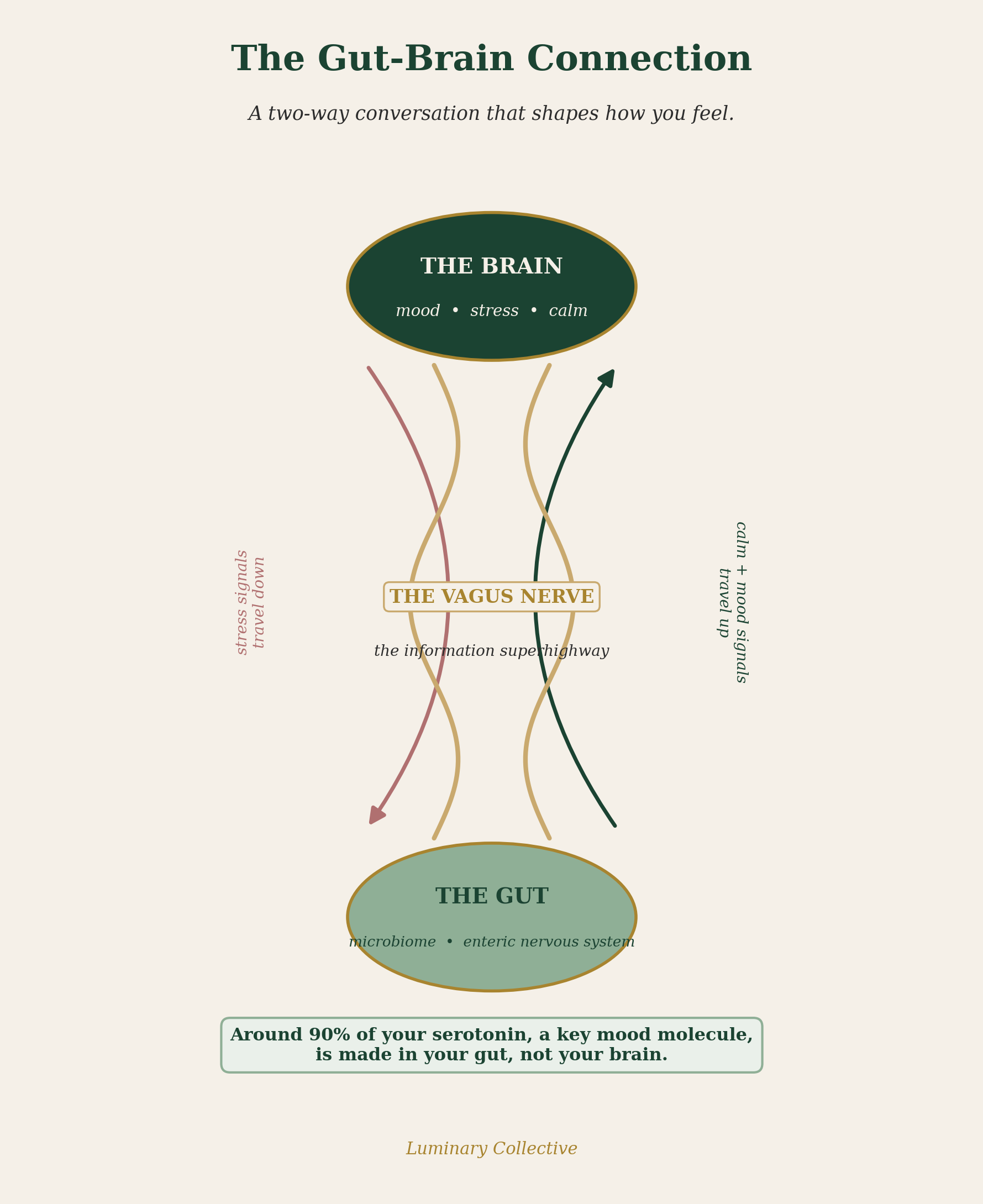
The two brains talk through the vagus nerve, a long nerve running from your gut to your brainstem. Think of it as an information superhighway. Gut-derived serotonin activates this nerve, sending signals to the brain regions that regulate emotion, stress, and mood.
And the trillions of bacteria in your gut are active participants. Certain ones, like Bifidobacterium and Lactobacillus, produce GABA, a calming neurotransmitter, while others boost serotonin. Oxford Academic The makeup of your microbiome is literally shaping the messages your brain receives.
Which brings us to the part that matters most if you have ever struggled with anxiety. When the gut falls out of balance, it can heighten your stress reactivity and elevate cortisol. And because the line runs both ways, stress then disrupts the gut health further. A loop forms: stress unsettles the gut, and the unsettled gut deepens the stress.
What my body taught me
For years, I treated my stress as something to push through, a mental hurdle to out-think. My body had other plans. Chronic stress eventually triggered an autoimmune condition, and I learned, painfully, that cortisol was one of the things that set off my flares. My mind and my body were not separate arenas. They were one system, and ignoring that truth cost me my health.
That was the turning point. When I finally stopped trying to think my way to wellness and started supporting the biology underneath it, regulating my nervous system, calming the stress that was actively deteriorating my health, everything changed. Not because I found a shortcut, but because I finally stopped working against my own body.
This is the heart of what I believe, and the whole reason Luminary Collective exists. You are not a mind piloting a body. You are one integrated biology. And when you support the physical systems beneath your experience, your nervous system, your hormones, your gut, you give your soul a better vehicle to move through this life. You activate your biology, and your existence rises to meet it.
The anxiety you have been trying to think your way out of may simply be your body asking to be supported.
Three ways to begin today
You cannot remake your gut overnight, but you can start tending this connection now.
Calm the highway. Vagal tone, your nerve’s capacity to regulate stress, can be strengthened through breathing, with practices like meditation and yoga helping ease anxiety. A few minutes a day of slow breathing with a long, gentle exhale sends a signal of safety along the very nerve linking your gut and mind. This is why breath is woven through everything I teach. It is not just relaxation. It is tending the wiring.
Feed what calms you. The bacteria that make your calming neurotransmitters feed on fiber and diverse plants. A plate rich in varied vegetables, fruits, legumes, and whole foods cultivates an internal garden that shapes your mood, and fermented foods like yogurt and sauerkraut add beneficial bacteria directly. One honest note: I am a wellness professional, not a dietitian, so take this as a principle to explore, not a prescription.
Protect the loop. Because the conversation flows both ways, lowering your stress directly protects your gut. Gentle movement, time in nature, real rest, and good sleep all guard the gut that is helping regulate your mood. Calm the system, and gut and brain begin to soothe each other.
The bigger picture
This is what I love about this science. You are not fragmented into a mind that feels and a body that carries it. You are whole. The butterflies, the gut feelings, the stress that lives in your stomach, these were never just metaphors. They are a real conversation, happening inside you all the time.
And that means you have more agency than you were told. When anxiety rises, it is not only something to analyze. It may be your body asking to be fed, breathed with, and calmed. You can join the conversation. You can change its tone.
If you are new here, this idea, that you are one integrated biology and can work with it rather than against it, is the foundation of everything I write. You can read where it all begins in my welcome post.
So the next time you get a gut feeling, pause and listen a little differently. Your gut has been speaking all along. Now you know it is worth hearing.
With warmth, Hannah