


I want to introduce you to a part of your body you’ve probably never thought about, but that may be quietly shaping how you feel every single day. It’s a deep muscle in your core called the psoas, and over the next few weeks, I’m going to take you on a journey into one of the most fascinating areas of the body-mind connection: how this muscle holds our stress, and how we can gently help it let go.
This is the first post in a four-week series on somatic movement and the psoas. It’s a topic I’ve become genuinely passionate about, because it sits at the exact intersection of everything I believe, that your body and your inner world are not separate, and that healing can happen through how we move. Let’s begin at the beginning: meeting this remarkable muscle.
What is the psoas?
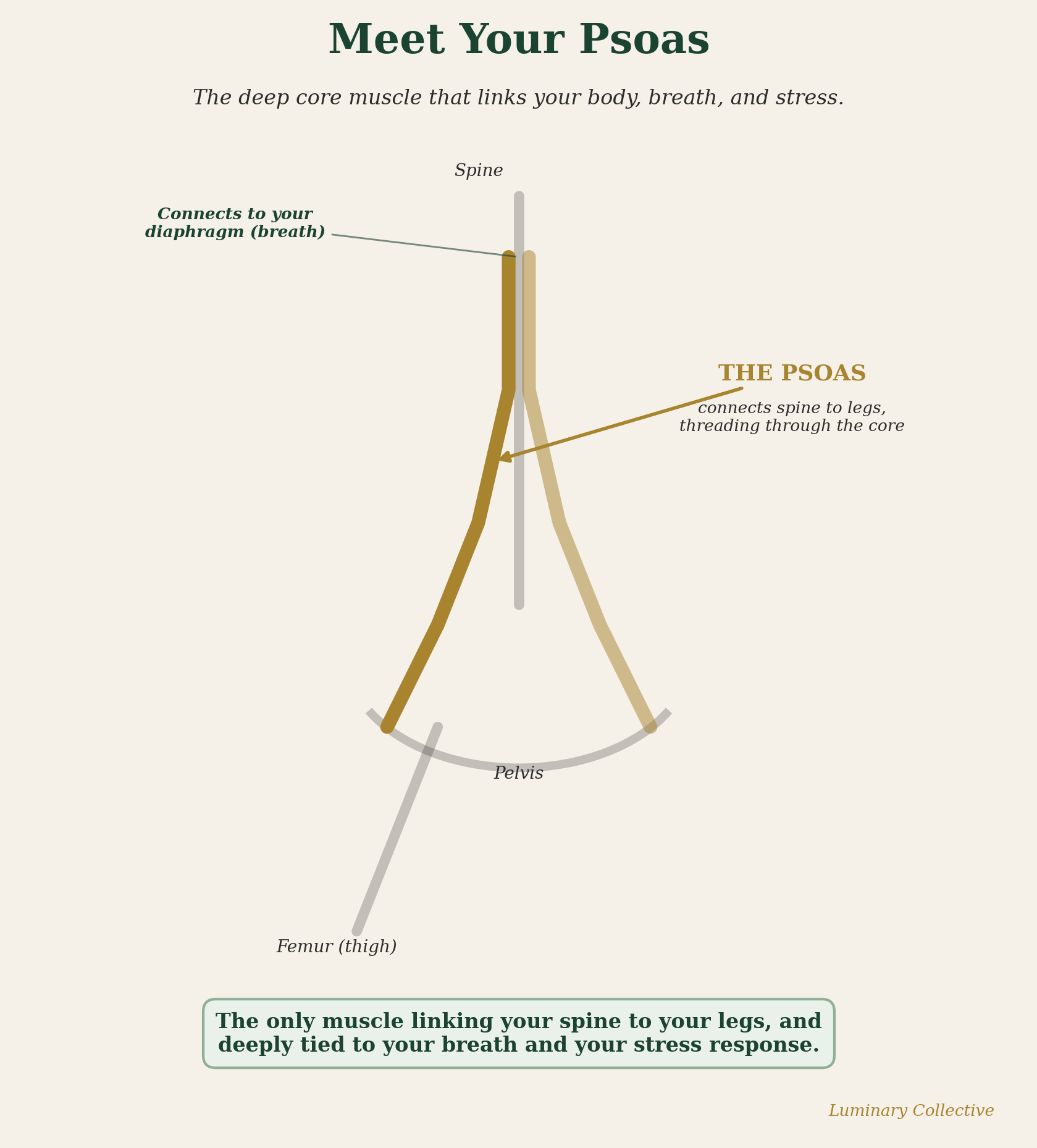
The psoas (pronounced SO-as) is a deep core muscle, and it’s unlike any other in your body. You actually have two, one on each side. They originate along your lumbar spine, thread down through your pelvis, and attach to the top of your inner thigh bone. This makes the psoas the only muscle that connects your spine to your legs.
Think of it as a suspension bridge running through the center of your body, linking your upper and lower halves, keeping you upright, stabilizing your core, and allowing you to walk, bend, and move. It sits deeper than your abdominal muscles, tucked close to your spine and your organs. Most of us have never felt it consciously, yet it’s working constantly, holding us up and moving us through the world.
Somatic practitioners have a beautiful name for it. They call the psoas the “muscle of the soul.” And that’s not just poetry, as you’ll see, it points to something real about how deeply this muscle is tied to our inner state.
Why this muscle is different
Here’s what makes the psoas so special, and why it’s the subject of an entire series. Most muscles are fairly straight forward, they contract and relax to move your bones. The psoas does that too. But because of where it lives and what it’s connected to, it plays a much deeper role in how you feel.
Two connections make it extraordinary. First, the psoas is intimately linked to your diaphragm, your primary breathing muscle, through connective tissue called fascia. This means your breath and your deep core are physically linked, your hips and your breathing are quite literally connected. Second, and this is what we’ll explore throughout this series, the psoas is deeply tied to your nervous system and your stress response. It’s one of the first muscles to respond when you feel afraid or threatened.
This is why the psoas is so much more than a hip flexor. It’s a bridge not just between your upper and lower body, but between your physical body and your nervous system, between how you move and how you feel. When it’s healthy and supple, it supports easy movement, deep breathing, and a sense of groundedness. When it’s chronically tight, as we’ll see, it can keep you stuck in tension and stress.
Why this matters for you
You might be wondering why a deep core muscle deserves your attention. Here’s why: because so many of the things we struggle with, low back tension, shallow breathing, a constant sense of being on guard, difficulty relaxing, can be connected to this muscle and the stress it holds. Learning about your psoas gives you a new lens on your own body, and a new pathway to feeling better, one that works with your body’s wisdom rather than against it.
And this is the heart of what draws me to this work. We so often treat our bodies as machines to be disciplined and our stress as something to think our way out of. But your body holds your experiences, and it can also be a doorway to releasing them. The psoas is one of the most powerful examples of this truth in your entire body.
Your takeaway to practice now: meet your psoas through constructive rest
I don’t want to leave you with just fascinating information, I want to give you something you can feel today. The gentlest, most foundational way to begin connecting with your psoas is a position called constructive rest. It’s simple, it requires nothing, and it’s the first step in inviting this deep muscle to relax.
Here’s how. Lie on your back on a firm, comfortable surface (the floor with a mat or rug is ideal). Bend your knees so your feet are flat on the floor, about hip-width apart, with your knees pointing up toward the ceiling. Let your feet be close enough to your body that your knees can rest without effort. You can let your knees fall gently toward each other if that feels more restful, or place a pillow between them. Rest your hands on your belly or by your sides.
Now simply be here. Don’t try to stretch or do anything. This position allows your psoas to release its constant work and settle, because your spine, pelvis, and legs are all supported. Breathe slowly and naturally, and imagine the deep center of your body softening. Stay for five to ten minutes.
That’s it. This gentle position is the foundation of all the psoas work we’ll do in this series, and it’s a beautiful practice on its own. Notice how you feel afterward, many people feel a subtle sense of release and calm. You’ve just begun a conversation with the muscle of your soul.
What’s coming in this series
Over the next few weeks, we’ll go deeper. Next week, we’ll explore the remarkable connection between your psoas, your breath, and your nervous system, and how you can use your breath to calm your whole body. Then we’ll look at how stress gets held in this muscle, and finally, the gentle art of releasing it. Each week, I’ll give you movements you can actually practice.
For now, I invite you to simply notice your body, and perhaps try constructive rest. You’re beginning to learn a language your body has been speaking all along.
If you are new here, this idea, that you are one integrated biology and can work with it rather than against it, is the foundation of everything I write. You can read where it all begins in my welcome post.
Welcome to the journey. I’m so glad you’re here.
With warmth,
Hannah