


Over the past two weeks in this series, we’ve met the psoas, the deep core muscle that connects your spine to your legs and lives at the crossroads of your body and nervous system, and we’ve explored how chronic stress can leave it stuck in a holding pattern, quietly bracing long after the stress has passed. Today, we arrive at the part everyone wants to know: how do you actually release it?
And here’s where the answer surprises almost everyone, because it goes against everything we’ve been taught about our bodies. You cannot force the psoas to let go. You can’t stretch it open through effort, push through it, or willpower it into relaxing. In fact, the harder you try to force it, the more it can brace. The psoas releases through one thing above all: safety. Let me show you why, and how to work with this muscle the way it actually asks to be worked with.
Why force doesn’t work
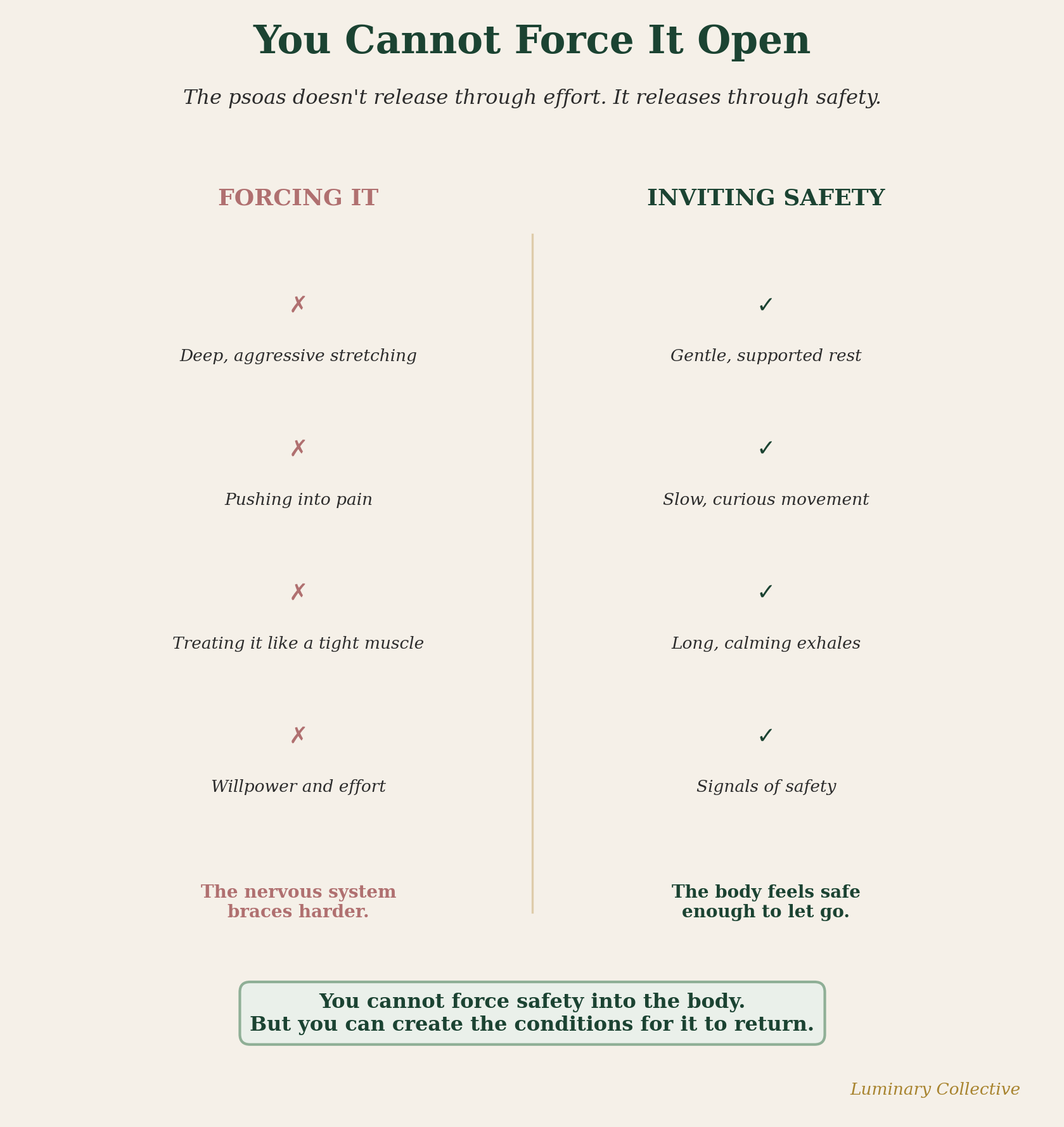
Here’s the crucial thing to understand. The psoas is a survival muscle, deeply wired to your nervous system, and it doesn’t respond to willpower or effort the way other muscles might. If your nervous system doesn’t feel safe, the psoas won’t release, no matter how long or how deeply you stretch it.
Think about what the psoas actually is: part of your body’s protective reflex, the same system that contracts when you brace for impact. It holds a kind of stored, instinctive memory of the times your body had to tense to protect itself. And this lives in the deep, ancient parts of your brain, the areas that govern survival, which don’t respond to logic, language, or force. They respond to one thing: cues of safety.
This is why aggressive stretching so often fails. You can stretch for years and still feel tight, because you’re treating a nervous-system holding pattern as if it were simply a short muscle. Worse, forcing, deep aggressive stretching or digging hard into the muscle, can actually be counterproductive, signaling threat to a muscle that’s already braced, so it holds tighter. As the somatic principle goes: the psoas doesn’t need to be pushed. It needs to feel safe enough to soften.
This reframe is everything. Releasing your psoas isn’t about effort. It’s about allowing. It’s not something you do to your body. It’s something you allow your body to do, once it feels safe enough.
How release actually happens
So if not force, then what? The answer is to create the conditions of safety, and let your body do the rest. Gentle, supported rest. Slow, curious movement. Long, calming exhales. These send a message along the very nervous system pathways that hold the tension, telling your body: the emergency is over, it’s safe to let go now.
This is why the practices in this series have centered on gentleness and breath rather than intensity. You’re not stretching a muscle. You’re communicating safety to your nervous system, and the muscle softens as a response. Slow, mindful movement paired with breath, and simply resting in supported positions, allow the psoas the time and space it needs to relinquish its grip. It often happens not with a dramatic stretch, but with a quiet, subtle sense of melting, of something you’ve been holding, without even realizing, finally releasing.
There’s a beautiful truth in this that reaches far beyond one muscle: you cannot force safety into your body, but you can create the conditions for it to return. That is the entire art of this work.
A gentle and honest word about emotion
I want to speak to something tender here, because it matters. Because the psoas holds the physical residue of stress and our protective responses, it’s not uncommon to experience an emotional release during or after gently working with it. As this deep, long-held tension begins to soften, feelings can surface, sometimes a wave of unexpected emotion, a welling of tears, or simply a profound sense of relief. This is normal, and it’s not something to fear. Our physical and emotional states are deeply intertwined; as we release physical holding, emotional holding can move too.
If this happens for you, be gentle. There’s nothing wrong. Your body is simply letting go of something it has carried for a long time. Let whatever arises move through you with kindness, and go slowly. This is also exactly why forcing is never the way, bullying this muscle can be upsetting both physically and emotionally, while a gentle approach lets release happen at a pace your body can integrate.
Your practice: a gentle psoas release
Here’s a simple, safe practice to invite release, building on the constructive rest we’ve been exploring. The whole point is to do less, not more.
Begin in constructive rest: lie on your back, knees bent, feet flat on the floor about hip-width apart, spine and pelvis supported. Rest your hands on your belly. Take several slow breaths, letting each exhale be long and unhurried.
Now, gently draw one knee in toward your chest, just enough to feel supported, keeping everything relaxed. Then slowly slide the other leg long along the floor, extending it out. As it extends, bring your awareness to the front of that extended hip, where the psoas lives. If you feel tension there, don’t push into it. Simply pause, breathe, and let your attention and your slow exhale invite that area to soften. Stay for five to ten slow breaths, feeling for any subtle sense of melting or ease. Then gently switch sides.
Notice the instruction is to feel and allow, never to force or push into a stretch. If at any point something feels sharp or painful, ease off, this work is never about pain. You’re not trying to achieve anything. You’re creating the conditions for your body to release on its own.
Afterward, return to simple constructive rest for a few minutes and just notice how you feel. Many people feel a quiet sense of relief, openness, or calm.
An honest and caring note
As I’ve shared throughout this series, I want to be transparent and responsible. I’m a movement and wellness professional, and I share this work because the connection between the body and nervous system is real and powerful. But I’m not a trauma therapist, and this work, while it can be genuinely healing, is not a substitute for professional mental health care. If deep emotion surfaces and feels overwhelming, or if you’re carrying heavy or traumatic experiences, please reach out to a qualified, trauma-informed professional who can support you safely. There are also wonderful trauma-informed practitioners, somatic therapists, and trauma-informed yoga teachers who specialize in exactly this. You deserve real support, and gentle movement can be a beautiful companion to it, not a replacement.
One more practical note: if you ever experience sharp or shooting pain, significant pelvic pain, numbness, or you’re navigating postpartum recovery, please work with a physical therapist or qualified movement professional rather than releasing on your own. Gentle care is powerful, but some situations call for expert, in-person guidance.
The bigger picture
This is the heart of what I believe and what Luminary Collective is built on. So much of our culture tells us that the way to change our bodies is through force, push harder, go deeper, power through. But your body doesn’t transform through force. It transforms through safety. The psoas is perhaps the most beautiful proof of this truth: the deepest release comes not from trying harder, but from finally letting your body feel safe enough to soften.
You did not choose the stresses that taught your body to hold on. But you can choose to stop fighting your body and start offering it what it truly needs, not force, but safety, patience, and gentleness. And in that softening, something profound becomes possible.
If you are new here, this idea, that you are one integrated biology and can work with it rather than against it, is the foundation of everything I write. You can read where it all begins in my welcome post.
Next week, in the final part of this series, we’ll bring everything together, integrating what you’ve learned into a supple, resilient core and a body that knows how to return to safety. For now, be gentle with yourself. Rest, breathe, and let go. Your body has been waiting for permission to soften.
With warmth,
Hannah