

In the first post of this series, we met the psoas, the deep core muscle that connects your spine to your legs and sits at the crossroads of your body and your nervous system. Today, we go deeper into what makes this muscle so remarkable, and so relevant to anyone living with stress: its role in your fear response.
Because here’s the thing that changed how I see movement forever. Your psoas isn’t just a muscle that moves you. It’s a muscle that responds to how safe or threatened you feel, and under chronic stress, it can get stuck holding on. Understanding this is the key to the whole series, so let’s explore it gently and honestly.
The psoas and the fear response
Think back to a moment when you were suddenly startled or frightened. Your body likely curled inward, your shoulders drew up, your torso folded slightly forward, an instinctive, protective posture. That response involves your psoas.
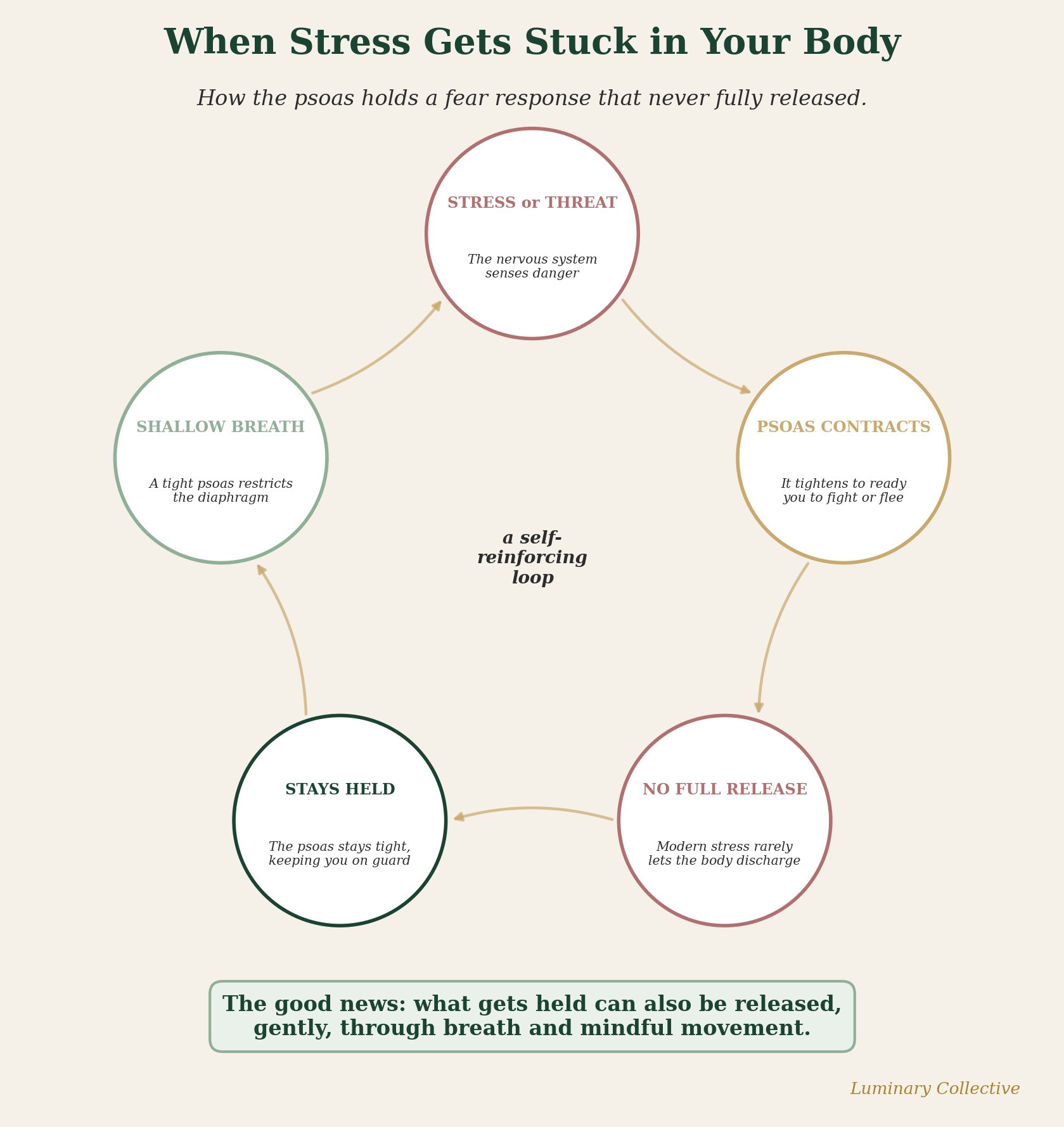
When your nervous system perceives a threat, it triggers your fight, flight, or freeze response, and your psoas is one of the first muscles to activate. It contracts, flexing your hips, either to prepare you to run or fight, or to curl protectively to guard your vital organs. This is ancient, instinctive, and automatic, wired into you over millennia as a survival mechanism. In a genuinely dangerous moment, this is exactly what you want. The psoas is, in a sense, one of your body’s first responders to fear.
In a healthy scenario, once the threat passes, your body discharges that activation and the psoas relaxes back to its resting state. The stress comes, the body responds, and then the body lets go. That’s the natural cycle.
How it gets stuck
But here’s what happens in modern life. Our stress is often not a lion that appears and then leaves. It’s chronic, ongoing, and rarely gives our bodies a clear moment to discharge and reset. Deadlines, worries, overwhelm, a constant low hum of pressure, this keeps our nervous system activated without resolution.
And when the fear response is triggered again and again without adequate recovery, the psoas can stay contracted. Instead of tightening and then releasing, it holds. Over time, it can become chronically shortened and tense, locked in a subtle, ongoing state of bracing. Some somatic teachers describe a chronically stressed psoas as becoming tired, tight, and even, in a sense, “dried up,” stuck in a holding pattern it never gets to release.
This creates a self-reinforcing loop, and it’s worth understanding. Stress contracts the psoas. The contracted psoas, sitting so close to your diaphragm, restricts your breathing, making it shallower. Shallow breathing reduces the activation of your calming, rest-and-digest nervous system. And that keeps you in a state of low-grade stress, which keeps the psoas contracted. Round and round. Your body can essentially get caught bracing for a threat that has long since passed.
What a held psoas can feel like
This matters because a chronically tight psoas doesn’t stay quietly in the background. It can show up in ways you might never have connected to a deep core muscle: persistent low back tension or discomfort, tightness in the hips, shallow breathing, a feeling of being unable to fully relax, or a subtle, constant sense of being on guard. Because the psoas is so tied to the nervous system, its tension and your emotional state can feed each other, physical holding and mental holding intertwined.
I want to be thoughtful here. This doesn’t mean every ache traces back to one thing, and the science of exactly how muscles “hold” stress is still developing. But the connection between chronic stress, this muscle, and the nervous system is real and increasingly understood, and countless people find that when they learn to release this deep tension, something shifts, not just physically, but in how they feel.
Your takeaway to practice now: soften with breath
Here’s something you can do today to begin interrupting that loop, gently. Since the psoas and diaphragm are connected, your breath is one of your most direct tools for inviting the psoas to soften. And because slowing your breath calms your nervous system, you’re working on both the muscle and the stress at once.
Return to the constructive rest position from Monday: lying on your back, knees bent, feet flat and hip-width apart, spine supported. Now bring your attention to your breath. Place one hand on your low belly. Breathe in slowly through your nose, letting your belly gently rise, feeling your breath move down into the deep center of your body. Then exhale slowly and completely, longer than your inhale, and as you do, imagine the deep core of your body, right where your psoas lives, softening and letting go.
Continue for a few minutes, slow breath in, longer breath out, each exhale an invitation to release. You’re not forcing anything. You’re simply using your breath to signal safety to your body and your psoas, gently teaching this deep muscle that it’s okay to stop bracing. This is the foundation of releasing held tension, and we’ll build on it next week.
An honest and caring note
Because this series touches on stress, fear, and how the body holds our experiences, I want to be clear and responsible. I’m a movement and wellness professional, and I share this work because the connection between the body and the nervous system is real and powerful. But I’m not a trauma therapist, and this work, while it can be genuinely healing, is not a substitute for professional mental health care. If you’re carrying heavy or traumatic experiences, please know that working alongside a qualified, trauma-informed professional is the most powerful path, and you deserve that support. Gentle movement can be a beautiful companion to healing, and it’s okay to need more than movement, too.
The bigger picture
This is the heart of what I believe and what Luminary Collective is built on. Your body has been holding so much for you, often without your awareness, bracing, protecting, carrying the weight of stress you may not have even known was there. That holding is not a flaw. It’s your body trying to keep you safe. And the beautiful truth is that what has been held can also be released.
You did not choose the stresses that taught your body to brace. But you can, gently and with patience, teach it that it’s safe to let go. That’s what the rest of this series is about.
If you are new here, this idea, that you are one integrated biology and can work with it rather than against it, is the foundation of everything I write. You can read where it all begins in my welcome post.
Next week, we’ll go deeper into the breath-psoas-nervous system connection, and how to use it to bring real calm to your body. For now, be gentle with yourself, and perhaps meet your breath in constructive rest. Your body is listening.
With warmth,
Hannah