


It is 3am. Your eyes open in the dark, and you are instantly, frustratingly awake.
Not groggy. Not drifting. Awake in a way that feels almost wired, your mind already turning before you have even decided to think, your body humming with an alertness you did not ask for. You lie there doing the quiet math on how little sleep you will get. And underneath the frustration is a question you have probably stopped asking out loud because no one ever had an answer: why does this keep happening to me?
I want to offer you a different way of hearing that question. Because your body is not malfunctioning at 3am. It is communicating. And once you understand what it is trying to say, you can finally respond to what it actually needs instead of fighting it in the dark.
This is one of the most common experiences women bring to me, and almost no one has ever explained it to them. So let us change that.
Your body keeps a clock, and right now it is set wrong
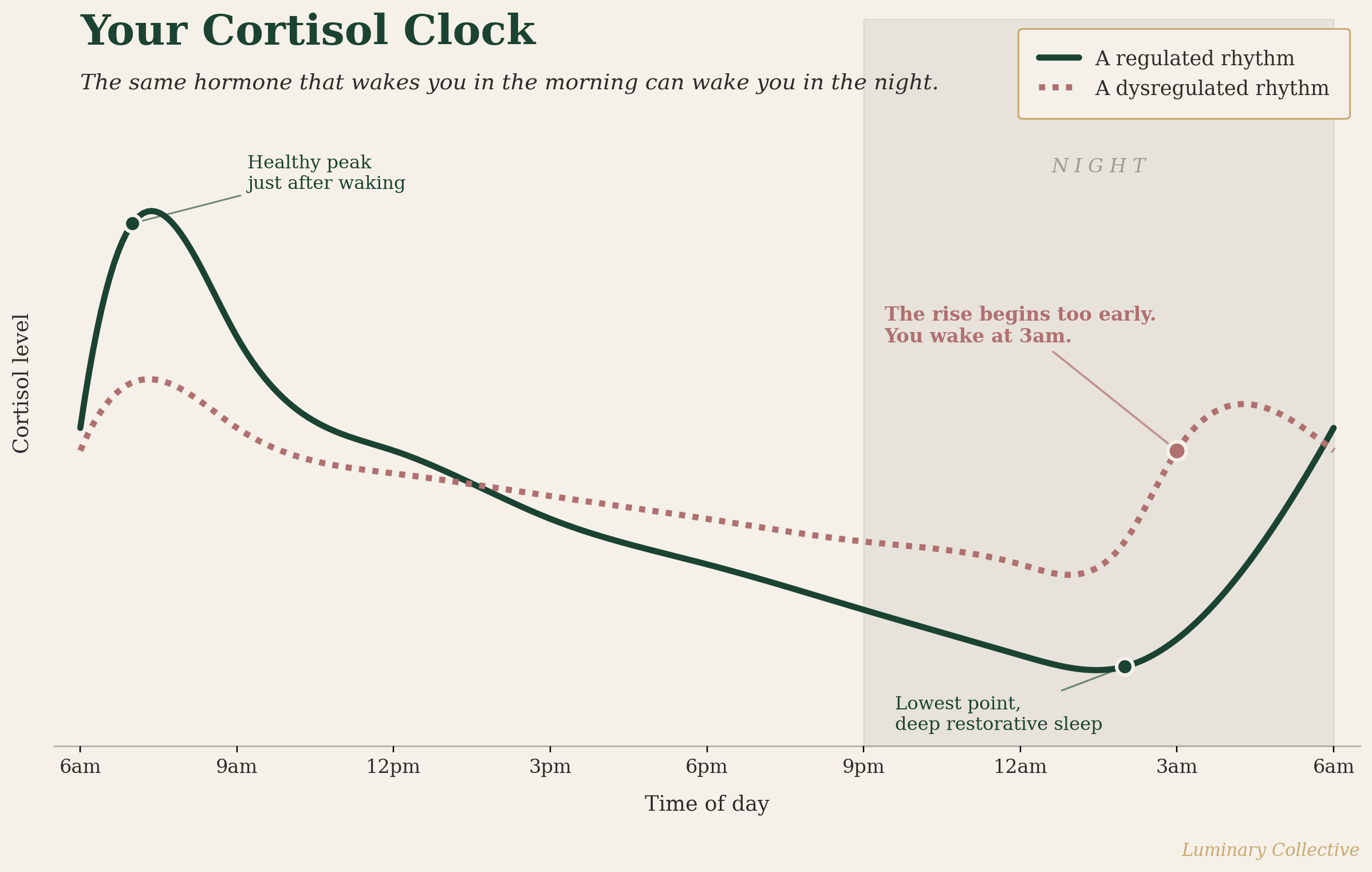
You know cortisol as the stress hormone. But that name hides its real job. Cortisol is also the hormone that wakes you up. It moves in a daily rhythm, lowest in the deep middle of your night, then rising in the early morning to carry you gently toward the surface of waking, peaking just after you open your eyes, then falling across the day so you can soften back into sleep at night.
When that rhythm works, you barely notice it. You wake feeling like yourself. But here is what is happening on the nights you bolt awake at 3am: that cortisol rise, the one meant to greet your morning, is arriving hours too early. Your internal clock has been set to the wrong time, and it is waking you for a day that has not started yet.
Why would your body do this? Because somewhere along the way, it learned it needed to. A nervous system that has been carrying sustained stress, the loud kind or the quiet kind that never fully switches off, adapts by staying ready. Vigilant. Braced. And a braced body does not produce the deep, unbroken sleep of a body that feels safe. It surfaces, again and again, scanning for a threat that is not in the room.
Read that again, because it is the whole point. Your 3am waking is not a personal failure. It is evidence of how hard your body has been working to protect you. It is loyalty, expressed at the worst possible hour.
Why this lands harder for women
There is a layer here almost no one explains. Cortisol does not act alone. It is in constant conversation with your reproductive hormones, estrogen and progesterone.
Progesterone is calming. It is sleep-supportive. So in the part of your cycle when progesterone drops, in the days before your period, an already-strained cortisol rhythm has less to soften it, and that 3am waking sharpens. This is why your sleep can feel like a different animal week to week, why you are not imagining that some nights your body simply will not stay down. Your hormonal landscape is shifting beneath you in real time, and your sleep is one of the first places you feel it.
This is not fragility. This is information. Your body is handing you a map of itself, if you are willing to read it.
What changes when you start listening
Here is what I most want you to understand, the thing that sits at the center of everything I write here: you cannot force a vigilant nervous system into rest. You cannot discipline your way out of this, supplement your way past it, or white-knuckle your body into sleeping. The harder you fight it, the more threat it perceives.
But you can change the signals. You can teach a braced body that it is safe to let go. And when you do, the change does not stay in the night. It shows up in your days.
Imagine waking before your alarm, clear instead of foggy, without the first thought of the day being how tired you are. Imagine an afternoon that does not collapse into a wall of fatigue at 3pm, where your energy holds steady enough that you stop white-knuckling your way to the evening. Imagine the particular relief of trusting your own body again, of getting into bed without the low dread of wondering whether tonight is another night you will be awake at 3am. That is not a fantasy. That is what happens downstream when the rhythm is restored.
Here are three evidence-based places to begin.
1. Anchor your wake time, even on weekends. This is the most powerful and most ignored lever you have. Waking at the same time every day, weekends included, strengthens your circadian rhythm and teaches your stress-response system when cortisol is actually meant to rise. Many people feel a real difference within a week. What you are doing, underneath the simplicity, is giving a dysregulated system something it craves: a predictable signal. You are showing your body the day has a shape it can trust. That trust is what eventually lets it stop waking you early to check.
2. Move your carbohydrates to the evening. This will sound wrong if you have absorbed the idea that carbs at night are a mistake. But research suggests that shifting nutrient-dense, complex carbohydrates, sweet potato, squash, rice, toward your evening meal, paired with protein and healthy fat, can help lower nighttime cortisol and support melatonin, the hormone that keeps you asleep. The reason this matters for you specifically: a body running on stress is prone to an overnight blood sugar dip, and that dip is one more thing that can surface you at 3am. A steadier evening means a steadier night. This is not about restriction. It is about giving your body fuel at the hour it actually needs it.
3. Use your breath as a built-in off-switch. When you do wake, what you do next decides how the next hour goes. Slow, long exhales activate your parasympathetic nervous system, the branch responsible for rest, and can lower cortisol within minutes. Try the 4-7-8 pattern: inhale through your nose for 4, hold for 7, exhale slowly through your mouth for 8, and repeat. Lying there letting worry spiral only tells your body the threat is real and keeps you alert. Your breath tells it the opposite. You are not waiting helplessly for sleep to return. You are actively sending the signal that it is safe to come back.
The bigger picture
Notice that none of these are about forcing anything. That is not an accident. It is the entire philosophy of Luminary Collective in miniature.
You did not choose the body you woke up in tonight. You did not choose the nervous system that learned to brace, or the rhythm that got set to the wrong hour. In a real sense, you inherited this pattern. But inheritance is not a life sentence. Your biology responds to how you live, which means you were built with the power to become a deliberate influence on it rather than a passenger to it. That is what freedom actually is. Not escaping your body, but understanding it well enough to work with it, until it begins to change.
The 3am waking was never the enemy. It was the invitation. A body asking, in the only language it has, to finally be heard.
If you are new here, this is the heart of what I do, and you can read where it all begins in my welcome post, where I share more of my own story and why I built this.
So the next time you find yourself awake in the dark, I hope something feels different. Not a failure. Not a mystery. A message. And now, finally, you know how to answer it.
We are just getting started.
With warmth, Hannah