


We have been sold a quiet lie about growth. That it happens alone. That transformation is a solo act of willpower, you against yourself, disciplining your way to a better life in private.
But your brain tells a different story. Neuroscience is now showing us something that reframes how change actually happens: your brain treats connection as a biological resource, and hard things genuinely become easier when you are not facing them alone. This is not a feel-good sentiment. It is measurable, and it changes everything about how you should approach your own growth.
Let me show you what the science reveals, and how you can use it.
Your brain runs on connection
There is a theory in neuroscience called Social Baseline Theory, developed by researcher Dr. James Coan, and its central finding is striking. The human brain expects access to relationships, and it uses those relationships to reduce the effort and risk of meeting life’s demands. In other words, your brain’s baseline assumption is not solitude. It is connection.
Here is the part that reframes everything. Your brain does not treat other people as external to you. It incorporates trusted people into its very representation of the self, folding them into how it calculates what you can handle. When supportive people are near, the brain’s response to threat and challenge actually diminishes, and the effort a task seems to require drops. When you feel supported, hard things literally feel more possible, because your brain is now managing the load as a shared one rather than a solitary one.
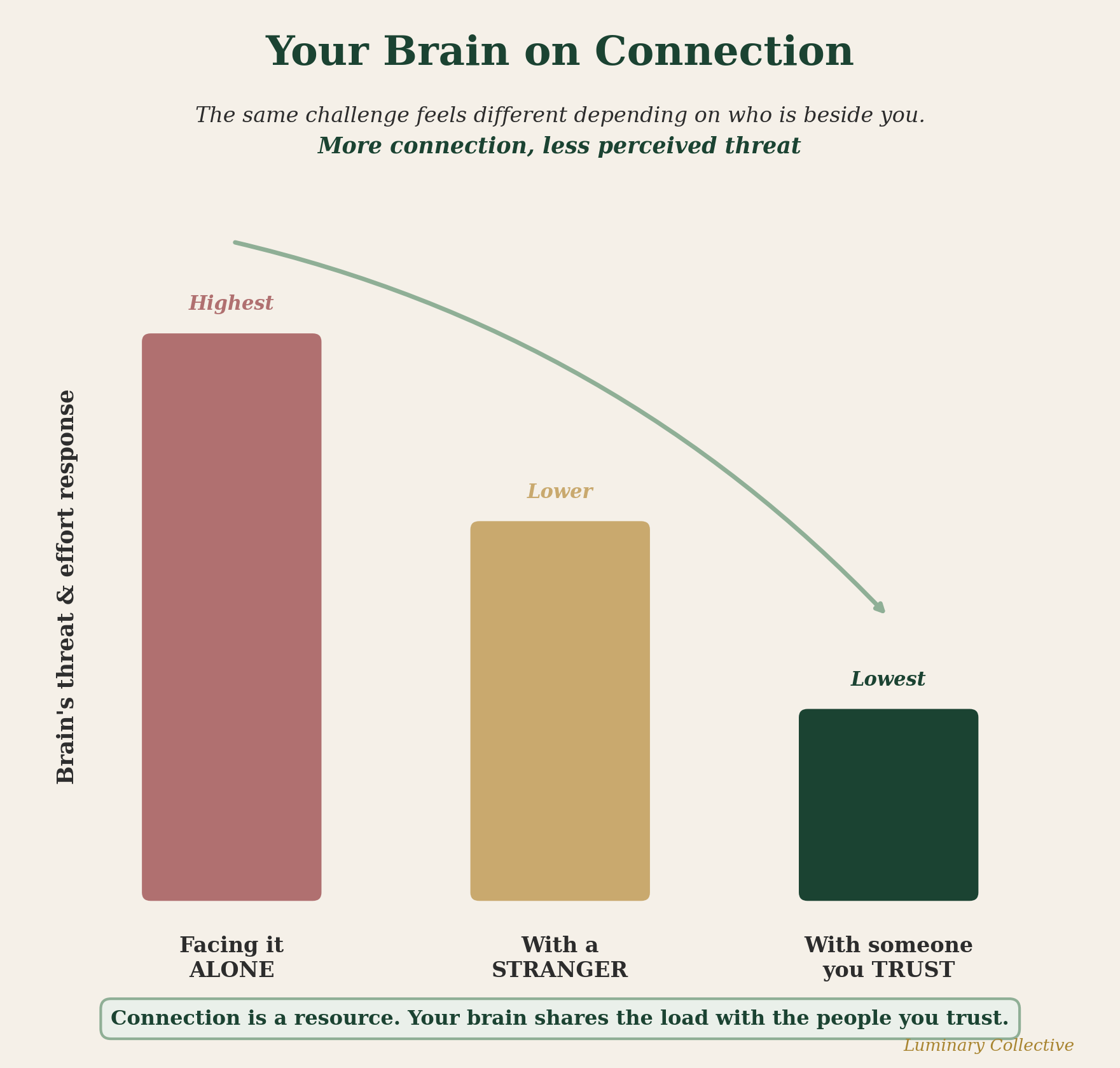
The same challenge, a different brain response, depending on who is beside you.
The evidence for this is remarkable. In a well-known study, women anticipating a mild electric shock showed measurably less activity in the brain’s threat centers when they held the hand of a trusted partner, compared to holding a stranger’s hand or facing it alone. Same threat, different brain response, determined entirely by connection. Support does not just feel better. It changes how your nervous system processes difficulty at a neurological level.
Why this makes growth easier
Think about what this means for changing your life. Growth is, by definition, hard. It asks you to face discomfort, tolerate uncertainty, and keep going when your old patterns pull you back. That is a heavy load for one nervous system to carry alone. And when the perceived effort is too high, we quit. Not because we are weak, but because the brain is constantly calculating whether the effort is sustainable.
Now add connection to the equation. When you pursue growth alongside others, your brain recalculates. The effort feels more manageable because, neurologically, it is being shared. The challenge that felt overwhelming in isolation becomes surmountable in company. This is why the woman attempting to transform her health alone, through sheer willpower, is fighting uphill, while the woman doing it in community has her biology working with her instead of against her.
There is a chemical layer to this too. Positive social connection influences neurochemistry, including oxytocin, which reinforces bonding and interacts with the brain’s reward and calming systems. Connection quite literally shifts your internal chemistry toward safety and reward, the exact state in which your nervous system feels regulated enough to change and grow.
And it runs deeper still, into how we regulate emotion. Research shows that human beings use others to help regulate their emotions as a way to conserve energy, that co-regulation is a fundamental feature of how we are built. When you are with someone whose presence calms you, your nervous system borrows their steadiness. This is not dependence or weakness. It is the design. We are wired to settle each other.
Why isolation makes everything harder
The reverse is equally important to understand. When we lack access to supportive connection, the brain must define the self as fully independent, and this increases perceived risk, effort, and even diminishes wellbeing. Facing your struggles in isolation is not just lonely. It is neurologically more expensive. Your brain has to shoulder the entire load alone, which raises the felt difficulty of everything.
So if you have been trying to transform your health, your habits, or your inner world by yourself and finding it exhausting, please hear this: it is not because you are failing. It may be because you are attempting something in isolation that your brain was never designed to do alone. The exhaustion is not a character flaw. It is a signal about how you are built.
How to use this
Understanding this science gives you a real advantage. Here are three ways to put it to work.
Stop trying to do it all alone. If you have been white-knuckling your growth in private, consider that you are making it harder than it needs to be. Seeking support is not a failure of self-reliance. It is working with your biology. Let this permission land: you were never meant to do this alone.
Choose your circle intentionally. Because your brain incorporates the people around you into its sense of what is possible, who you surround yourself with genuinely shapes your capacity to grow. Seek out people who are moving in the direction you want to go, whose presence calms rather than depletes you. Their steadiness becomes a resource your nervous system can draw on.
Pursue growth in community, not just in solitude. Whether it is your health, a new habit, or inner work, doing it alongside others changes the neurological math. Shared effort is lighter effort. This is precisely why transformation tends to stick in community and dissolve in isolation, and it is worth building your growth around.
The bigger picture
This is one of the deepest truths of what it means to be human, and it sits at the heart of what I am building. We were never meant to do this alone. Our nervous systems were shaped over millennia of facing life together, sharing burdens, and regulating one another through connection. The modern idea that you should be able to transform in isolation, through willpower alone, runs against your very biology.
When you understand that connection is a resource, you stop seeing your need for others as weakness and start seeing it as wisdom. You activate your biology, the way it was actually designed, wired for each other, and your growth becomes not only easier, but shared, and far more sustainable.
If you are new here, this idea, that you are one integrated biology and can work with it rather than against it, is the foundation of everything I write. You can read where it all begins in my welcome post.
So the next time you set out to change something in your life, do not retreat into isolation to do it. Reach for connection. Your brain, and your growth, will thank you.
With warmth, Hannah