


You have probably done this. You decide, with total conviction, that this time you will follow through. You will stick to the plan, hold the boundary, build the habit. And for a few days, running on sheer determination, you do. Then life gets stressful, or you get tired, and the resolve quietly crumbles. And you are left with a familiar, sinking thought: what is wrong with me? Why can’t I just be more disciplined?
I want to take that weight off your shoulders, because it is built on a myth. The belief that lasting change comes down to willpower is not just discouraging, it is scientifically wrong. And once you understand what actually drives change, you can stop blaming yourself and start working with your brain instead of against it.
Willpower is a limited resource
Here is the first thing the science makes clear. Willpower is not a character trait that some people simply have more of. It is a finite, depletable resource, and it is least available exactly when you need it most.
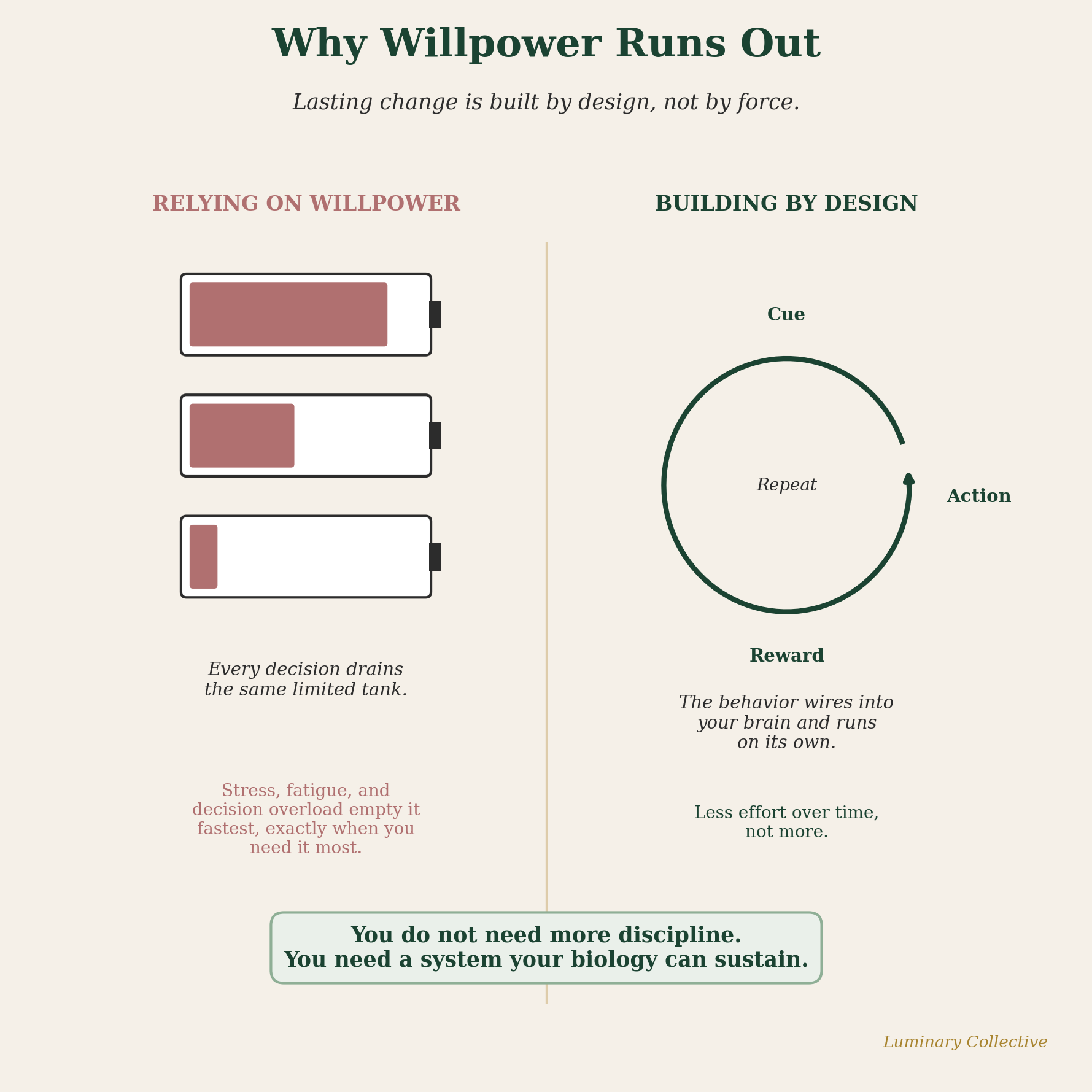
Think of willpower like a battery. Every act of self-control draws from the same limited charge, resisting a craving, pushing through a task you dread, holding your temper, making yet another decision. And research shows that stress, fatigue, and decision overload drain that battery fastest. Which means that by the end of a long, demanding day, precisely when you are trying to make a good choice, your willpower is running on empty. This is not weakness. It is how the brain is built.
So if you have noticed that your discipline collapses when you are stressed or exhausted, you are not failing. You are experiencing a completely normal, predictable feature of human neurology. Willpower was never designed to carry lasting change on its own.
How change actually happens
Here is the liberating part. The behaviors that truly last are not the ones you force through willpower. They are the ones that become automatic, wired so deeply into your brain that they no longer require much effort at all.
This happens through habit formation, and it runs on a different system than willpower entirely. Willpower lives in the prefrontal cortex, the effortful, conscious, easily tired part of your brain. But habits live in the basal ganglia, a deeper region that runs behaviors automatically, with minimal effort. When you repeat a behavior in a consistent context, your brain gradually transfers it from the effortful system to the automatic one. Eventually it runs almost on its own, the way brushing your teeth does. You do not need willpower for that, because it has become wiring.
The mechanism is a simple loop: a cue triggers a behavior, the behavior earns a reward, and repetition wires it in. Over time, the cue alone sets the behavior in motion, before you even consciously decide. And here is a myth worth correcting while we are at it: this does not happen in twenty-one days. Research from University College London found it takes an average of about sixty-six days for a behavior to become automatic, though it varies widely from person to person. So if a new habit has not “stuck” in three weeks, nothing is wrong with you, you were simply working from a made-up timeline.
Why this matters, especially if you have “tried everything”
I care about this one deeply, because so many of the women I work with have spent years believing their struggles come down to a personal lack of discipline. They have white-knuckled diet after diet, plan after plan, blaming themselves each time their willpower ran out. The shame compounds, and shame, research shows, does not create change. It just creates more stress, which drains the very willpower they are counting on.
If that is you, please hear this clearly. You do not lack willpower. You have been relying on the wrong tool for the job. Lasting change was never meant to be forced into place through sheer effort. It is meant to be built, deliberately, into your environment and your routines, until it runs on its own.
How to build change by design
Here is how to stop depending on willpower and start engineering change that lasts.
Design your environment, not your discipline. Research consistently shows that shaping your surroundings is more effective than willpower for building new habits. Make the behavior you want easy and obvious, and the one you want less of harder and less visible. When your environment does the work, you do not have to spend willpower you may not have.
Anchor new habits to existing ones. One of the most effective techniques is to attach a new behavior to something you already do automatically, a practice often called habit stacking. After I pour my morning coffee, I take three slow breaths. The established routine becomes the cue, so you are not relying on memory or motivation to get started.
Choose it, keep it small, and make it enjoyable. A 2024 review found the habits that formed fastest were the ones people chose for themselves, did earlier in the day, and actually enjoyed. Force and dread work against you. Ease and genuine enjoyment wire a behavior in faster. Start smaller than feels impressive, and let it be something you do not hate.
Expect about sixty-six days, and protect your consistency. Since automaticity takes time, the goal in the early weeks is simply to repeat the behavior consistently in the same context, not to rely on it feeling effortless yet. Consistency, not intensity, is what does the wiring. Miss a day, and you simply begin again, no shame required.
The bigger picture
This is the heart of what I believe and what Luminary Collective is built on. Your struggles to change are not evidence of a broken character or a shortage of willpower. They are usually evidence that you were handed the wrong strategy, one that told you to force your way to a better life through sheer discipline, when your brain was never designed to work that way.
You did not choose a brain that runs on habit and wiring rather than endless willpower. Every human brain does. But you can choose to stop fighting that design and start using it, building the changes you want into your environment and your days until they become who you are. That is not a lack of discipline. That is working with your biology, which is the only kind of change that truly lasts.
If you are new here, this idea, that you are one integrated biology and can work with it rather than against it, is the foundation of everything I write. You can read where it all begins in my welcome post.
So the next time your willpower runs out, do not reach for shame. Reach for a better design. You were never meant to force this. You were meant to build it.
With warmth,
Hannah