


There is a specific kind of exhaustion that sleep does not fix.
You drag yourself through the day, running on fumes, promising your body rest. And then night comes, and the moment you finally lie down, something flips. Your mind races. Your body hums with a restless energy it refused to give you all day. You are bone-tired and completely unable to switch off, at the same time.
If this is you, there is a name for it, and a real biology behind it. It is often called being wired but tired, and it is one of the most common things I see in women who are doing their best and cannot understand why they feel this way. You are not lazy, and you are not broken. Your body has lost its natural rhythm. Let me show you what that means, and how it can be restored.
Your body runs on a rhythm
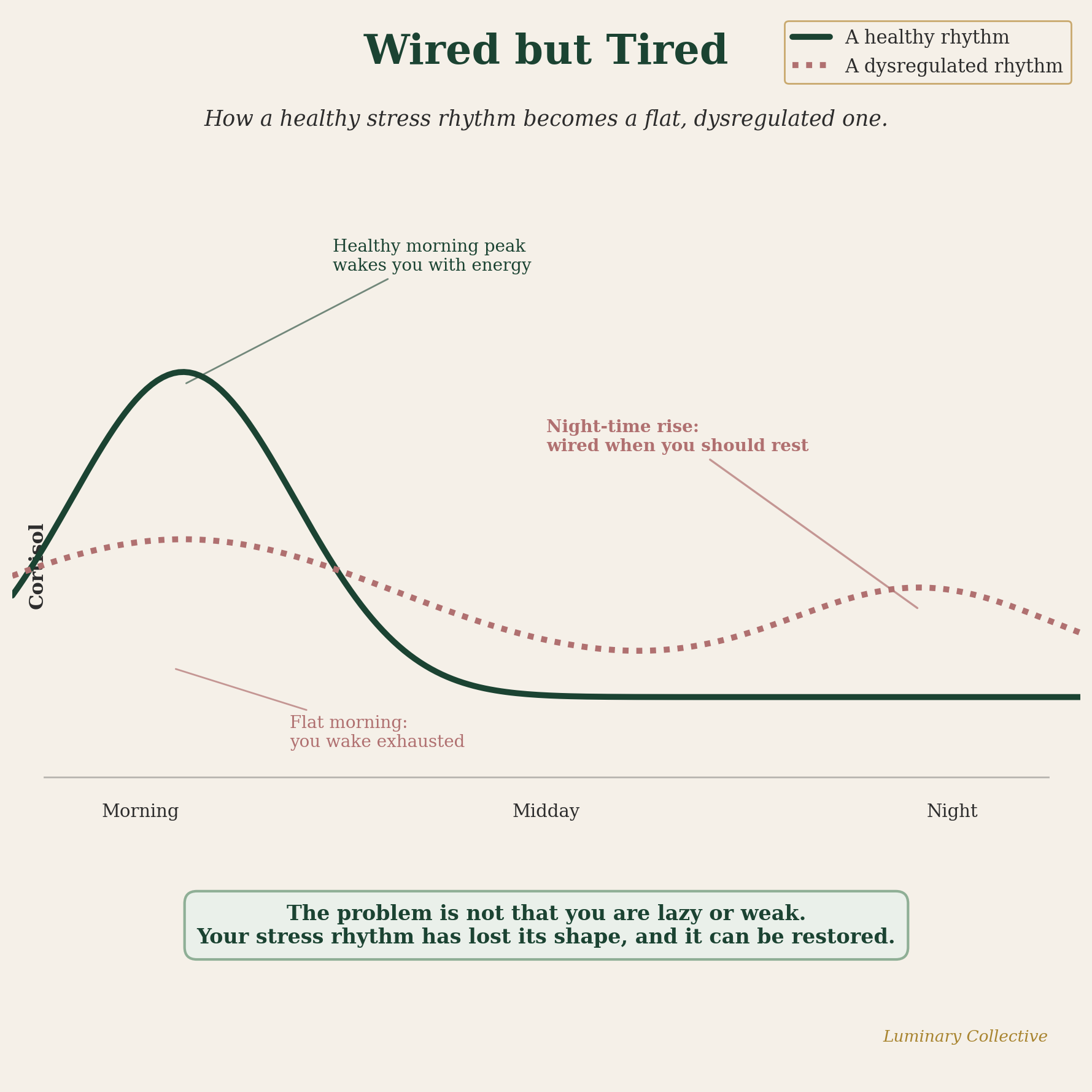
Your stress-response system, known as the HPA axis, is meant to follow a daily rhythm, and cortisol is its conductor. In a healthy pattern, cortisol rises to a peak in the morning to wake you up and carry you into your day with energy, then gradually declines, reaching its lowest point at night so you can wind down and sleep deeply.
When this rhythm is intact, you barely think about it. You wake feeling reasonably rested, you have energy through the day, and you get sleepy at night. The system switches on when you need it and off when you do not. That flexibility is what a healthy stress response actually looks like.
But that rhythm is not guaranteed. And when life asks too much of it for too long, it can lose its shape entirely.
How the rhythm breaks
Here is what happens under chronic stress, the loud kind or the quiet, unrelenting kind that never fully switches off. Your stress-response system stays activated when it is meant to rest. At first, it floods you with cortisol over things that should not even register as threats, leaving you feeling constantly on edge, anxious, and wired. But no system can stay on high alert forever. Over time, that constant signaling wears down the entire communication network, and the rhythm flattens.
The result is the wired but tired pattern. Instead of a strong morning peak, your cortisol comes up flat, so you wake exhausted no matter how long you slept. And instead of tapering to a low at night, it can rise at the wrong time, leaving you alert and restless exactly when you are trying to rest. Your rhythm has essentially inverted. The energy you desperately needed in the morning shows up at midnight instead.
This is what the research now calls HPA axis dysregulation, and it is important to understand the reframe here. The older idea of adrenal fatigue suggested your glands were simply worn out and empty, but the evidence does not support that model. Your adrenals are not broken. The problem is a communication breakdown between your brain, your hormones, and your nervous system, a rhythm that has lost its shape. And a rhythm can be re-learned.
Why this matters so much for women
I want to be honest about why I care about this one deeply. This is not only about feeling tired. A chronically dysregulated stress response is a whole-body issue, and research links it to disrupted sleep, brain fog, anxiety, mood swings, cravings, poor recovery, and even immune dysregulation.
That last one is personal for me. Chronic stress and a dysregulated HPA axis are increasingly connected to autoimmune conditions, and my own autoimmune diagnosis was a large part of what taught me this. I lived the wired but tired pattern for a long time before I understood it, exhausted, inflamed, unable to rest, and pushing harder in exactly the way that kept the cycle going. Learning that my stress rhythm itself was dysregulated, and that I could help restore it, changed everything about how I cared for myself.
So if you are living in this pattern, please hear this. Your exhaustion is not a character flaw or a lack of discipline. It is a signal that the load has been too high for too long, and your body is asking for something different than pushing harder.
How to restore your rhythm
The encouraging truth is that the HPA axis can recalibrate with consistent support. You are not stuck here. The goal is not to eliminate stress, which is impossible, but to restore your system’s flexibility, so it can switch on when needed and off when it is time to rest. Here is where to begin.
Anchor your mornings with light and movement. Getting natural light and gentle movement early in the day helps signal your body to produce cortisol when it is actually supposed to peak. This is one of the most direct ways to rebuild a healthy morning rhythm, so your energy starts showing up at the right time.
Protect your evenings from false alarms. Bright light, screens, and intense stimulation at night can push your stress system to rise when it should be falling. Dimming lights, slowing down, and creating a genuine wind-down period tells your body the day’s emergencies are over, and it is safe to rest.
Practice switching your system off, on purpose. A dysregulated nervous system has often forgotten how to downshift. Slow, long-exhale breathing, gentle movement, and moments of real stillness actively train your body to return to a calm state. You are teaching the off switch to work again, a little more each day.
Stop trying to out-train your exhaustion. This one matters most for the woman who responds to fatigue by pushing harder. If your system is dysregulated, relentless high-intensity training adds more stress and deepens the pattern. Prioritizing recovery, sleep, and gentler movement is not giving up. It is exactly what allows your rhythm to heal.
The bigger picture
This is the heart of what I believe and what Luminary Collective is built on. Your exhaustion is not a personal failing to be pushed through. It is information. Your body is not working against you, it is telling you, in the only language it has, that the way you have been living has asked more than it can sustain, and that it needs a different kind of care.
You did not choose the rhythm your body fell into, or the years of stress that shaped it. But you can choose, gently and consistently, to help it find its shape again. And when you do, the energy that has felt so out of reach begins to return, at the right time, in the right rhythm, the way it was always meant to.
If you are new here, this idea, that you are one integrated biology and can work with it rather than against it, is the foundation of everything I write. You can read where it all begins in my welcome post.
So the next time you feel wired but tired, do not reach for guilt or push harder. Recognize it for what it is: a rhythm that lost its shape, and a body ready to be brought home.
With warmth,
Hannah
I needed this, cause I have the most inconsistent sleep schedule and I just assumed it’s a type of insomnia or something or a symptom of adhd/asd