


You already know the feeling. Your chest tightens before a hard conversation. Your breath goes shallow when a stressful message comes through. Your body bracing before your mind has even caught up.
Here is something it took me years of studying the body to fully believe: you are never more than one breath away from changing your physiological state.
Most of us treat breathing as background noise. It happens without our permission, so we assume it is outside our control. But breath is unusual among our automatic functions. Your heart rate, your digestion, your hormone release all run on autopilot, yet breath is the one system you can reach in and adjust by hand. That single fact makes it one of the most accessible tools you have for shifting how you feel, think, and function.
This is not a wellness trend. It is neurobiology. And it sits at the heart of what I believe: that you are not at the mercy of your body, but in a lifelong conversation with it, one you can learn to direct.
Why breath works
Your breath talks directly to your vagus nerve, the primary communication line of your parasympathetic nervous system, the branch responsible for rest, digestion, and recovery. Slow your breath down and lengthen the exhale, and you send your body a direct signal to stand down from stress. Speed it up, or hold it in a specific pattern, and you can sharpen focus or calm a spike of anxiety in under a minute.
This is what I mean when I say you can activate your biology. Your nervous system is always listening to your breath, reading it for cues about whether you are safe or under threat. Most of us let that conversation run by accident. Learning to breathe on purpose is learning to speak your body’s language.
Below are three practices, each studied in a real lab, each solving a different problem. I have organized them by what they do for you, not just how to do them, because the purpose behind a practice is what makes you actually stick with it.
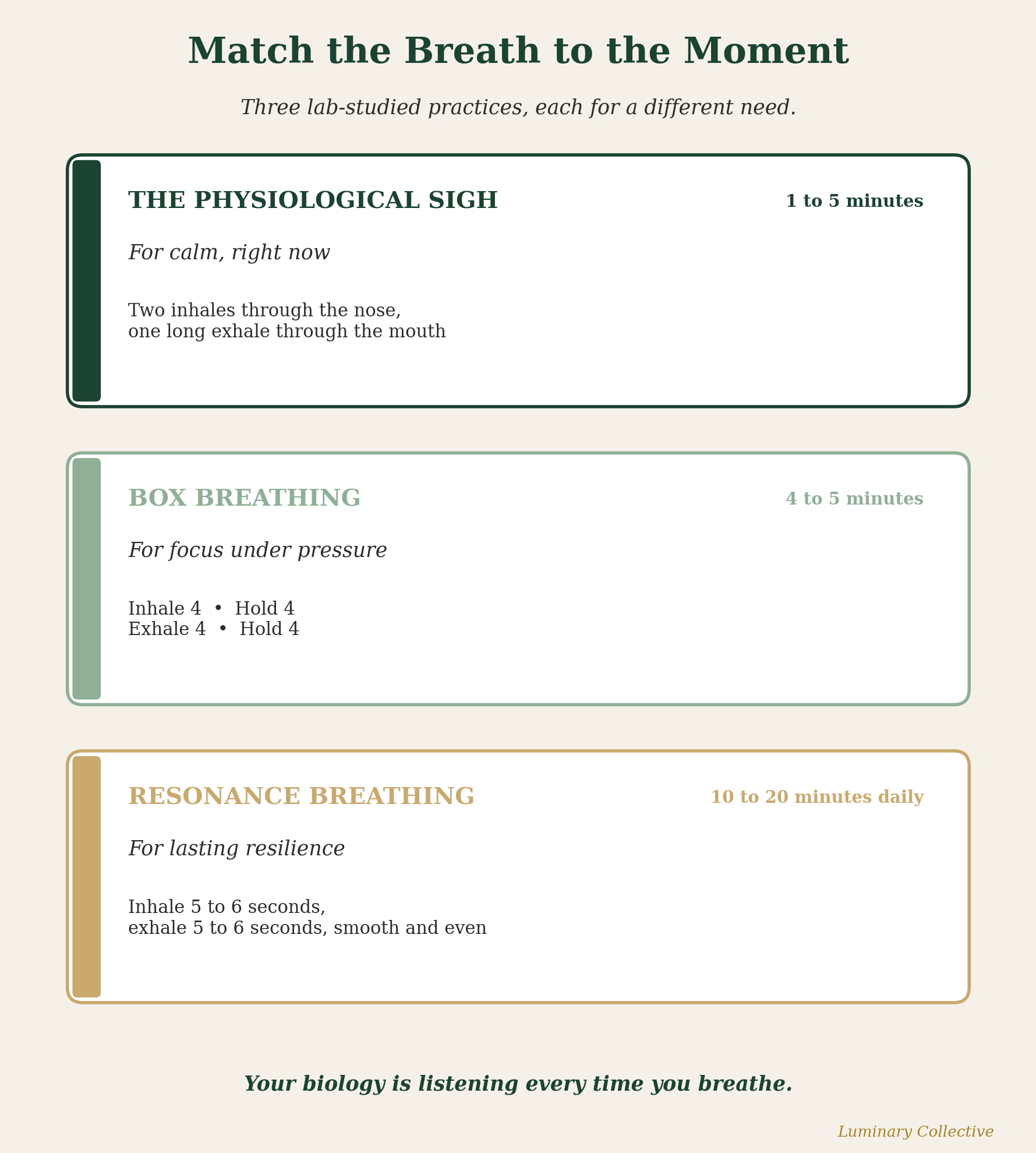
Match the breath to the moment. Three practices, three purposes, all free and always available.
1. The Physiological Sigh: for the moment you need calm right now
The purpose: to release built-up stress and reset your nervous system in under a minute, no matter what is happening around you.
Stanford researchers David Spiegel and Andrew Huberman tested this pattern against box breathing and mindfulness meditation in a randomized controlled trial of over one hundred volunteers. Across the study, the exhale-focused cyclic sighing produced greater improvement in mood and a greater reduction in breathing rate than mindfulness meditation.
The mechanism is elegant. When you are stressed, your breathing becomes shallow, and tiny air sacs in your lungs called alveoli begin to collapse, which reduces how efficiently you exchange oxygen and carbon dioxide. The double inhale, two quick sniffs in rapid succession, reinflates those collapsed sacs. This is not a strategy your body had to invent. It is the same thing it does involuntarily during sleep, which is why the natural version is called a sigh.
How to do it: Inhale through your nose until your lungs feel about half full. Without exhaling, take a second, shorter sniff to top them off completely. Then release it all in one long, slow exhale through your mouth, longer than the inhale felt. Repeat for one to three cycles when you need immediate relief, or continue for five minutes for a deeper reset.
Keep this one in your back pocket for the moment before a hard conversation, the second after a stressful text, or anytime your chest feels tight and your thoughts start to spiral.
2. Box Breathing: for steady focus under pressure
The purpose: to train your nervous system toward calm, sustained attention, especially before something that asks you to perform.
Box breathing uses equal counts across four phases of the breath, and it was one of the techniques compared directly against cyclic sighing in that same Stanford trial. While cyclic sighing edged it out for mood in that particular study, box breathing still calms the body reliably and gives your mind a rhythm to anchor to, which is exactly why it is used by Navy SEALs, surgeons, and athletes before high-stakes moments.
It works because the breath holds interrupt the urge to rush. When you are anxious, your instinct is to breathe faster and shallower. Box breathing forces the opposite, slow, even, deliberate, which tells your nervous system there is no emergency here.
How to do it: Inhale through your nose for a count of four. Hold gently for four. Exhale for four. Hold at the bottom, lungs empty, for four. Repeat for four to five minutes.
Use this before a workout, a presentation, a race start at run club, or anytime you need your mind sharp and your body settled at once.
3. Resonance Breathing: for long-term resilience
The purpose: to train your body’s baseline stress response over time, so you are steadier by default, not just in the moments you remember to breathe on purpose.
This one works differently than the first two. Rather than solving an acute spike, resonance breathing, also called coherent breathing, is a daily practice that gradually raises your heart rate variability, one of the most respected markers we have for nervous system health and stress resilience. Heart rate and breathing naturally synchronize into resonance at about six breaths per minute, though each person’s exact resonance point tends to fall somewhere between four and a half and seven breaths per minute. As you slow your breathing toward that point, the amplitude of your heart rate variability increases significantly.
A randomized controlled study on young adults found that four weeks of daily resonance breathing produced measurable improvements in nervous system balance, while the control group who did not practice showed no change over the same period. Put simply, the body does not change on its own. The practice is what does the work.
How to do it: Sit comfortably with your shoulders relaxed. Inhale gently through your nose for five to six seconds. Exhale gently through your nose for five to six seconds. Keep it smooth and unforced, roughly even on both ends. Continue for ten to twenty minutes daily. Consistency matters more than duration, so ten minutes done daily will outperform twenty minutes done occasionally.
This is the one I recommend pairing with your morning routine or your wind-down before bed. It is not designed to fix a hard moment. It is designed to change what your hard moments feel like over time.
Which one should you start with
If you remember only one thing from this post, remember this: match the practice to the problem.
For acute stress, right now, in the moment, use the physiological sigh, one to five minutes. For focus and steadiness before performance, use box breathing, four to five minutes. For long-term nervous system resilience, use resonance breathing, ten to twenty minutes daily.
None of these require an app, a class, or any equipment. They ask only for your attention, and your willingness to treat your breath as something worth directing on purpose rather than something that simply happens to you.
This is the whole philosophy of Luminary Collective in a single practice. You did not choose the nervous system you inherited, or the stress patterns that got wired into it. But you are not stuck with them either. Your breath is proof. It is always available, always free, and always ready to help you change your state from the inside.
If you are new here, this idea, that you are one integrated biology and can work with it rather than against it, is the foundation of everything I write. You can read where it all begins in my welcome post.
Your biology is listening every time you breathe. The question is what you are telling it.
With warmth, Hannah