


Listen, for a moment, to the voice in your head. The one that narrates your day. When you make a mistake, what does it say? When you catch your reflection, or fall short of something, or replay an awkward moment at 2am, what tone does it take?
For so many of us, that inner voice is harsh. Relentless. We’d never speak to a friend the way we speak to ourselves. And we tend to think it doesn’t really matter, that it’s just thoughts, just the background noise of being human. But here is something that might change the way you treat yourself forever: that inner voice is not just thoughts. It is a physical event in your body. Every time you speak to yourself, kindly or cruelly, you are changing your brain chemistry, your hormones, and your nervous system, in real time.
This is one of the most hopeful areas of neuroscience, because it means that learning to be kinder to yourself isn’t soft or self-indulgent. It’s one of the most direct, biological ways to change how you feel. Let me show you what’s actually happening, and then give you simple things you can do today.
What self-criticism does to your brain and body
Here’s the first thing to understand, and it’s striking. When you criticize yourself, your brain doesn’t experience it as helpful motivation. It experiences it as a threat.
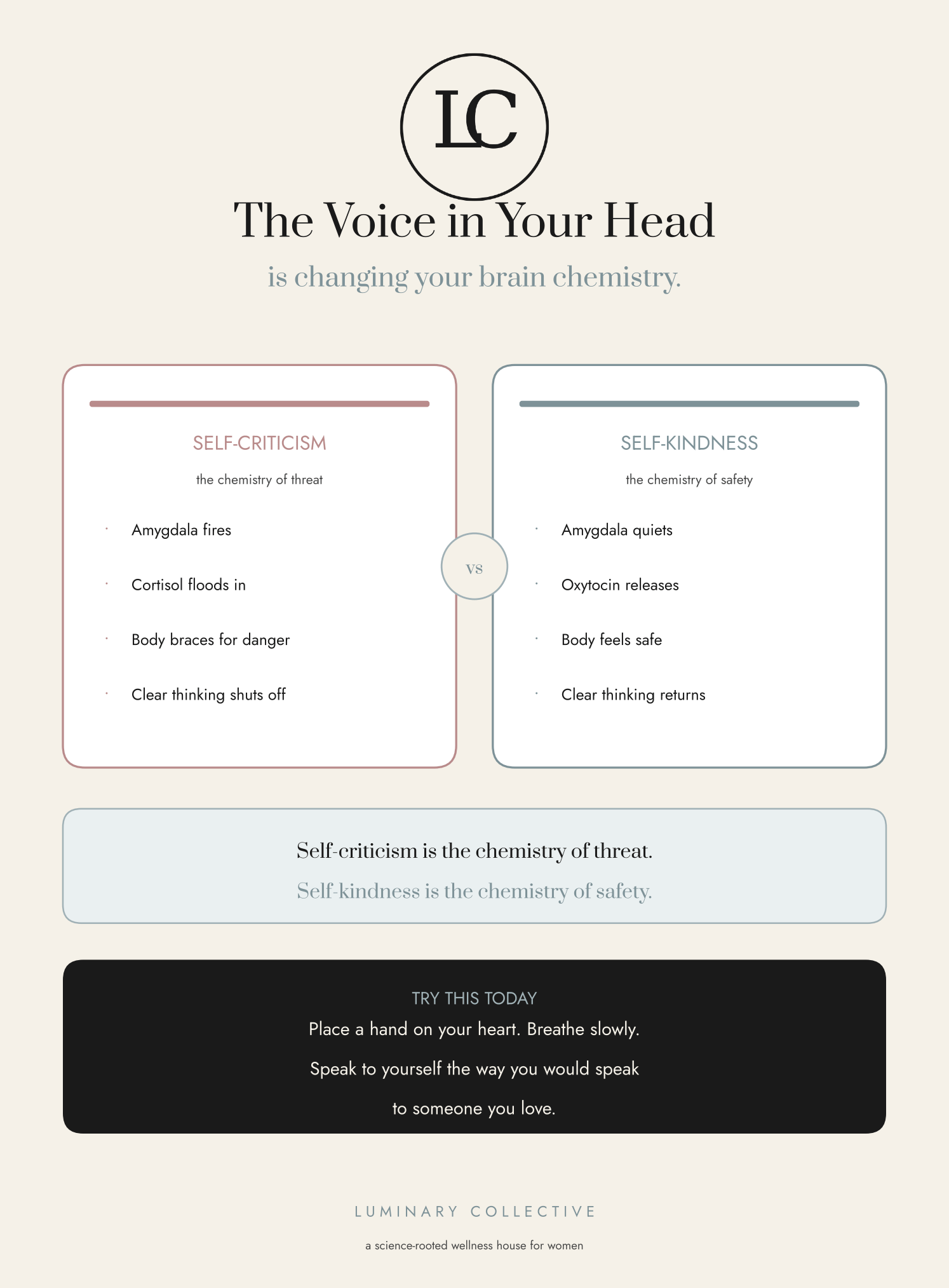
When you think things like “why am I like this” or “I should have known better,” your brain registers danger, and it activates your threat system, the same fight-flight-freeze response you’d have facing an actual predator. Your amygdala, the brain’s alarm center, lights up. And your body floods with cortisol, the stress hormone, preparing you for danger that isn’t there. In other words, self-criticism puts you in a physiological state of stress, over and over, from the inside.
This matters enormously, because chronic activation of that threat response doesn’t make you better. It wears you down. Research is clear that harsh self-criticism doesn’t motivate us long-term; it increases stress, anxiety, and emotional exhaustion. And here’s the cruelest part: that threat state actually impairs the very brain functions you need to grow and improve, your prefrontal cortex, your clear thinking, your emotional regulation. When your survival brain is activated, your wise, capable brain goes offline. So the inner critic you thought was pushing you forward is quite literally shutting down your ability to think clearly and change.
What self-kindness does instead
Now here’s the beautiful part, the part that can genuinely change your life.
When you treat yourself with kindness and understanding, you activate a completely different system in your brain: the care and soothing system, the same ancient circuitry that lights up when a mother comforts her child. And instead of cortisol, this system releases oxytocin, often called the “love hormone,” linked to feelings of safety, warmth, and connection.
The effects ripple through your whole body. Oxytocin calms the amygdala, quieting your threat response and reducing anxiety and fear. It lowers cortisol. It shifts your nervous system out of fight-or-flight and into a parasympathetic, rest-and-restore state, your body gets the message that you are safe. Research even shows that people who practice self-compassion have measurably lower cortisol in stressful situations and healthier daily cortisol rhythms. Self-kindness, quite literally, changes your chemistry toward calm.
And remember what happens when the threat response switches off: your prefrontal cortex, your clear, logical, capable thinking, comes back online. So being kind to yourself doesn’t make you weak or complacent. It’s the opposite. It creates the exact internal state, calm, safe, regulated, in which you can actually think clearly, regulate your emotions, and grow. Self-compassion researchers have found it’s not the soft option; it’s a foundation of genuine mental strength.
Here is the line I want you to hold onto: self-criticism activates the chemistry of threat. Self-kindness activates the chemistry of safety. You are choosing one or the other, all day long, with the voice in your head.
This is a skill, and your brain can learn it
If your inner critic is loud, I want you to hear this with real compassion: it is not your fault, and it is not permanent. That critical voice is often an old, automatic pattern, your brain’s misguided attempt to protect you (it learned, somewhere, that being hard on yourself kept you safe or accepted). But what’s automatic can be rewired. Thanks to neuroplasticity, every time you practice responding to yourself with kindness instead of criticism, you strengthen those soothing neural pathways and weaken the threat-based ones. You are, with practice, literally rebuilding the voice in your head. It gets easier, and more natural, over time.
And the lovely part is that the oxytocin and calm that self-compassion creates actually support neuroplasticity itself, creating the ideal brain state for forming new, healthier patterns. Kindness builds the very conditions for change.
Things you can do today to shift your chemistry
Here’s what I love about this: you don’t have to wait. You can begin changing your inner chemistry right now, with small, genuine practices. Here are a few to try today.
Talk to yourself like you’d talk to someone you love. The next time you catch that harsh inner voice, pause and ask: “Would I say this to my best friend, or my little sister?” If not, offer yourself what you’d offer them instead. This isn’t fluff, it’s a direct way to switch your brain from the threat system to the care system. Try it the very next time you make a mistake today.
Place a hand on your heart. This sounds almost too simple, but it’s grounded in real science. Physical self-soothing touch, like placing a warm hand on your heart or gently holding your own arm, can trigger the release of oxytocin and activate your calming system, even when it’s your own hand. The next time you feel stressed or self-critical, try it: hand on heart, a slow breath, and a kind word to yourself. Your body responds to the gesture of care.
Use the “self-compassion break.” Researchers developed a simple three-part practice for hard moments. When you’re struggling, silently say: first, “This is a moment of difficulty” (acknowledging the pain). Then, “Difficulty is part of being human, I’m not alone in this” (remembering your shared humanity). Then, “May I be kind to myself right now” (offering yourself warmth). It takes thirty seconds and it genuinely shifts your state. Use it today the next time something feels hard.
Reframe your inner narrator from critic to coach. A good coach is honest but encouraging, they want you to succeed, so they don’t scream insults. When you notice self-criticism, try translating it into what a caring coach would say. “You’re so behind, what’s wrong with you” becomes “This is hard, and you’re doing your best, what’s one small next step?” Same honesty, completely different chemistry.
Pair kindness with your breath. Since both self-compassion and slow breathing calm your nervous system, combine them. Place your hand on your heart, take a few slow breaths with long exhales, and silently offer yourself one kind phrase: “I’m doing the best I can.” You’re sending your body a double signal of safety.
Notice the critic without obeying it. You don’t have to win a fight with your inner critic. Just noticing it, “ah, there’s that harsh voice again”, creates a little space between you and the thought, and reminds you that you get to choose how to respond. Awareness alone begins to loosen its grip.
The bigger picture
This is the heart of what I believe and what Luminary Collective is built on. We are not separate from our biology, we are one integrated system, and the way we treat ourselves is not just emotional, it’s physical. The voice in your head shapes your hormones, your nervous system, your capacity to think and feel and grow. Which means that learning to be kind to yourself is not a luxury or an afterthought. It is one of the most powerful, science-backed things you can do for your health, your brain, and your whole life.
You did not choose the inner critic you may have developed, or the patterns that taught you to be hard on yourself. But you can choose, gently and with practice, to build a kinder voice, and in doing so, to literally change your chemistry toward safety, calm, and clarity. You are not being soft. You are working with your biology exactly as it was designed to be cared for.
One honest note: if your inner critic feels overwhelming, or you’re struggling with persistent anxiety, depression, or the weight of heavy experiences, please know that working with a therapist can be genuinely life-changing, and you deserve that support. Self-compassion is a beautiful practice, and it pairs wonderfully with professional care; it isn’t a replacement for it.
If you are new here, this idea, that you are one integrated biology and can work with it rather than against it, is the foundation of everything I write. You can read where it all begins in my welcome post.
So today, catch that inner voice just once, and soften it. Put a hand on your heart. Speak to yourself like someone worth being kind to, because, biologically and in every other way, you are.
With warmth,
Hannah