


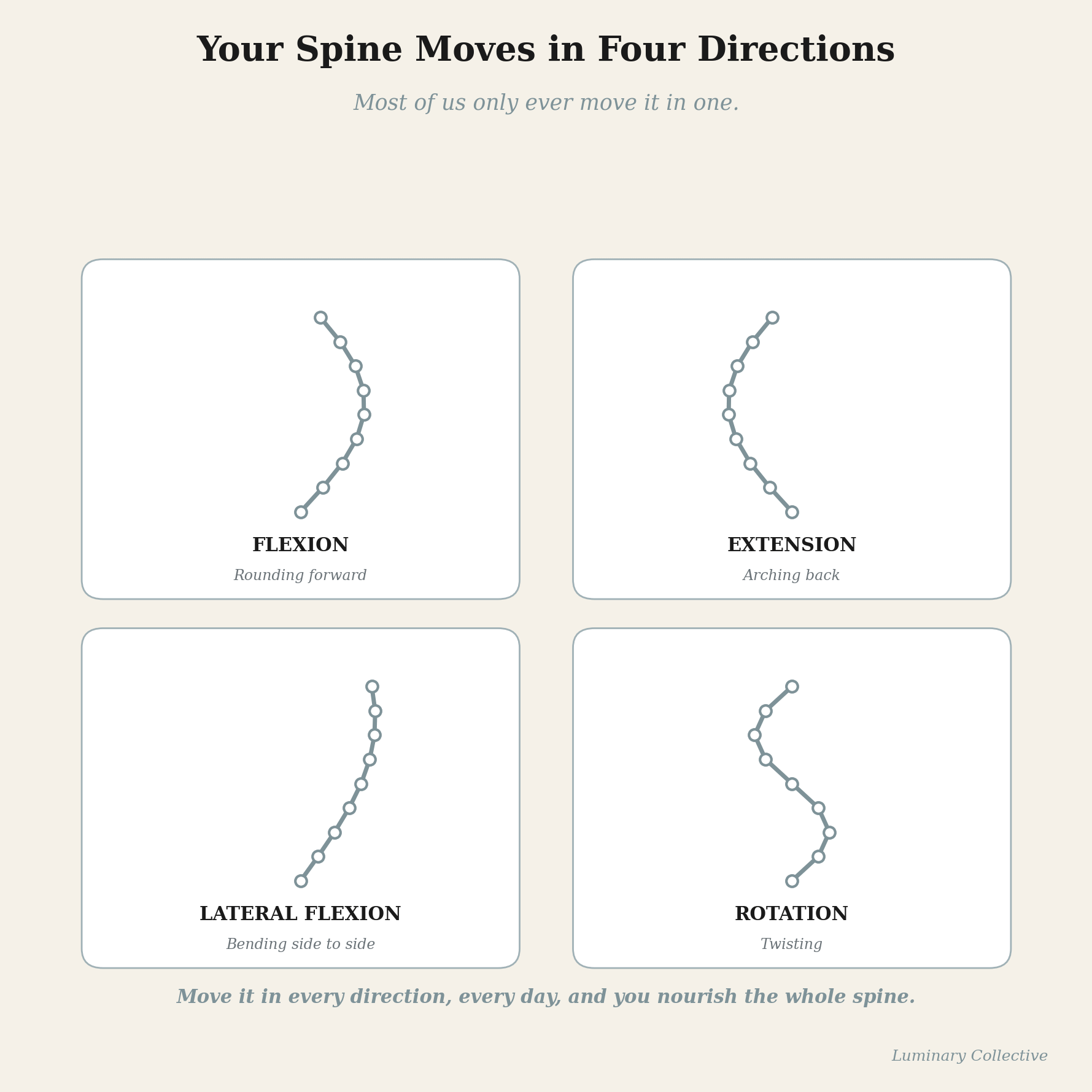
Here is something worth sitting with for a moment. Your spine is capable of moving in four distinct ways. It can round forward (flexion). It can arch back (extension). It can bend to each side (lateral flexion). And it can twist (rotation). It was designed, exquisitely, to move in every one of these directions.
Now think about how you actually move it on a normal day. You sit, rounded slightly forward, at a desk, in the car, on the couch, over your phone. You reach forward. You bend forward. And that is more or less the whole story. Most of us spend our entire day moving our spine in a single direction, forward, and never take it through the other three at all. Our spines are built for a full, rich range of motion, and we use a tiny fraction of it.
I want to offer you a different daily practice, one that is simple, takes just a few minutes, and addresses something most spinal advice completely overlooks: moving your spine, on purpose, through every plane it was made for. Let me explain why this matters so much and then give you the practice.
Why your spine needs movement in every direction
Here is the piece of science that reframes everything. Your intervertebral discs, the cushions between your vertebrae, have no direct blood supply. Unlike most of your tissues, they cannot passively receive nutrients from your bloodstream. Instead, they rely on movement itself to stay healthy. When your spine moves through its full range, that motion pumps fluid in and out of the discs, delivering nutrients and flushing out waste. Movement is quite literally how your discs are fed.
This changes how you think about spinal care. It is not just that movement feels good or prevents stiffness, though it does both. It is that your spine depends on being moved through its full range to nourish the very structures that keep it healthy. And “full range” means all four directions, not just the one we default to. When you only ever move your spine forward, entire regions of it rarely get the fluid exchange they need. Moving through every plane is how you feed the whole spine.
There is a name for this kind of movement: spinal articulation. It means moving the spine segment by segment, with control, through its available range while taking your spine through all of the directions it was built for. Research on spinal mobility work shows that this kind of controlled, full-range movement, practiced daily, improves range of motion and reduces stiffness, often noticeably within just a few weeks. And a daily practice of even ten to fifteen minutes is enough to make a real difference.
The practice: move your spine in every plane, every day
Here is a simple sequence that takes your spine through all four of its movements. You can do this in a few minutes, most days. The whole point is slow, controlled, gentle movement, feeling your spine move segment by segment rather than forcing any shape. Never push into pain; stay within the range that feels good and available to you.
1. Flexion and extension (rounding and arching). Come onto your hands and knees, or sit tall in a chair. Slowly round your spine, dropping your head and tucking your tailbone, letting your back curl one vertebra at a time (this is flexion, the direction you already know well). Then slowly reverse it, arching gently, lifting your chest and tailbone, moving segment by segment into a soft backbend (this is extension, the direction most of us almost never do). Move back and forth slowly with your breath, five to eight times. Feel each part of your spine participate. Extension especially is a gift here, it counteracts all those hours spent rounded forward.
2. Lateral flexion (side bending). Sitting or standing tall, reach one arm up and over, gently bending your spine to the opposite side, feeling a long curve open down the side of your body. Come back to center, then bend to the other side. Move slowly, a few times each way. Notice how rarely your spine gets to move like this in daily life. Side bending brings movement and fluid to the sides of your spine that forward-hunched living completely neglects.
3. Rotation (twisting). Sitting tall, place your hands lightly on your shoulders or rest them in your lap. Slowly rotate your upper body to one side, letting your spine gently twist, then return to center and rotate to the other side. Keep it slow and controlled, moving from your center rather than yanking with your arms. A few rotations each way. Twisting is one of the most functional movements your spine can do, and one of the most underused.
That is the whole practice: rounding and arching, bending side to side, and twisting both ways. In just a few minutes, you have taken your spine through every plane it was designed to move in, something most people go entire days, even years, without doing.
A few insights to make this genuinely effective
Move slowly and feel each segment. The magic of articulation is in the control. Rather than moving your spine as one stiff block, try to feel it move piece by piece, like a chain, or a string of pearls rolling one at a time. This segment-by-segment awareness is what actually restores mobility, and it is a skill that grows with practice.
Do it daily, even briefly. Consistency matters far more than duration here. A few minutes every day will do more for your spine than a long session once in a while, because you are feeding your discs and maintaining your range continuously. Tuck it into a moment you already have: first thing in the morning (when your spine is stiffest and most grateful for movement), or as a break from sitting.
Extension and rotation deserve extra love. Because modern life keeps us rounded forward and facing straight ahead, the two directions we lose most are extension (arching back) and rotation (twisting). If you only remember two things, gently arch back and gently twist, every day. You are giving your spine exactly what your daily life takes away.
Let it feel good, never forced. This is not about achieving a big range or pushing into a deep stretch. It is about gently visiting every direction. Stay in the range that feels available and pleasant. Over time, that range will naturally open, but the point is the movement itself, not the depth.
The bigger picture
This is the heart of what I believe and what Luminary Collective is built on. So often we think caring for our bodies requires something big, an intense workout, a dramatic fix. But some of the most powerful things you can do are quiet, simple, and daily. Taking your spine through its full range of motion is a perfect example: a few minutes of gentle, intentional movement that nourishes your discs, preserves your mobility, and keeps you moving freely through your life.
Your spine was built for a rich, full range of motion, to bend and arch and twist and curve. When you honor that design, even for a few minutes a day, you are working with your body exactly as it was meant to be used. That is what lasting wellness actually looks like: not force, but gentle, consistent care that meets your body where it is.
One honest note: this is general movement education for a healthy spine, not medical advice. If you have persistent back pain, a known spinal condition, or any numbness, tingling, or weakness, please work with a doctor or a spine-focused professional before beginning, and let them guide what is right for your body.
If you are new here, this idea, that you are one integrated biology and can work with it rather than against it, is the foundation of everything I write. You can read where it all begins in my welcome post.
So today, take a few minutes and move your spine in every direction it was made for. Round and arch. Bend side to side. Twist. Your spine has so much more range than your day usually asks of it. Give it back the movement it was built for.
With warmth,
Hannah